

SEO vs GEO: What Do PR Leaders Need to Know About GEO and AI Discovery?
 On 18 décembre, 2025
 9 min
9 min
Summary
-
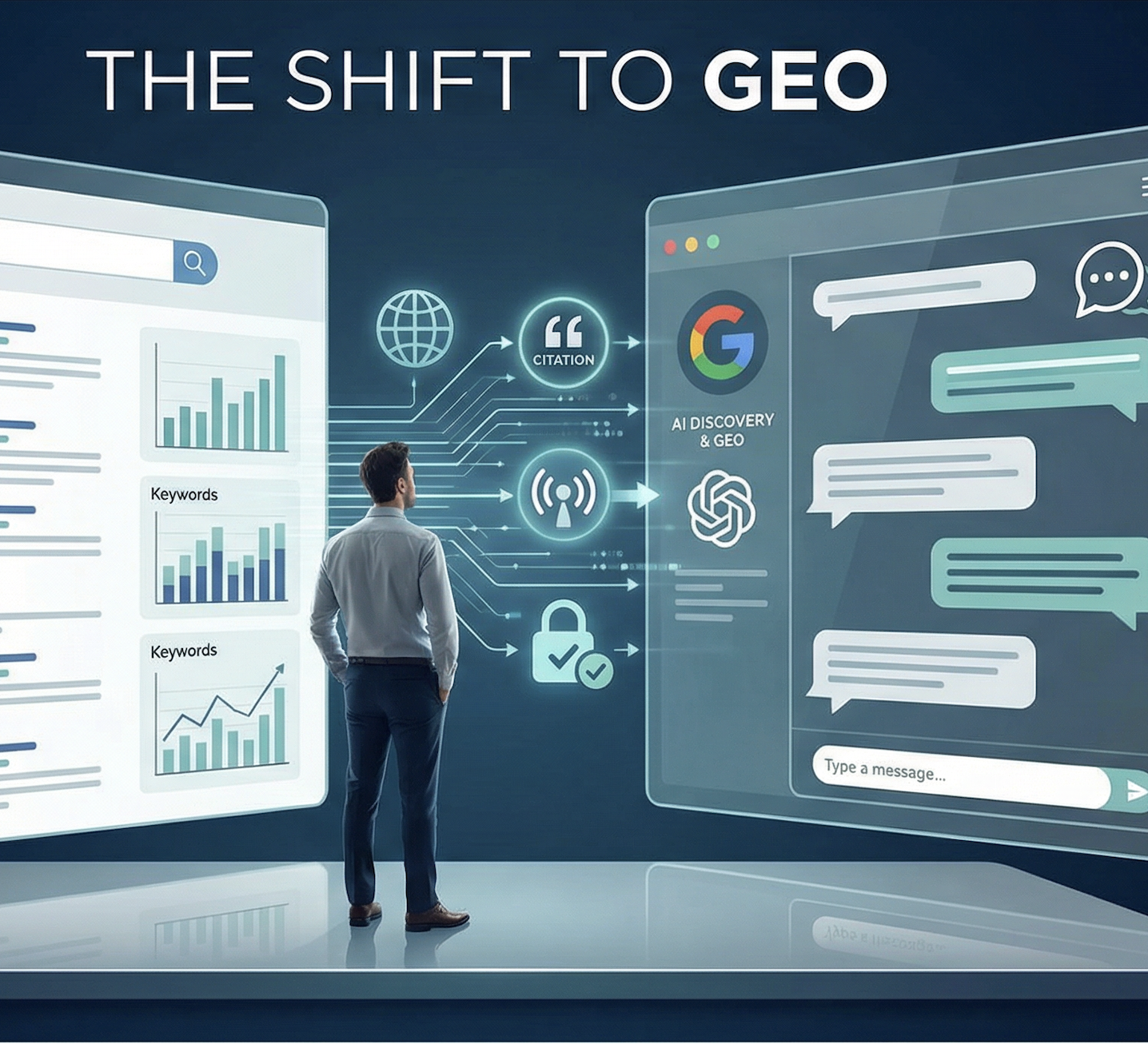
GEO focuses on how brands are cited and trusted inside AI-generated answers (ChatGPT, Gemini, Meta, Perplexity, Copilot), while SEO still centers on ranking web pages in traditional search results.
-
SEO remains essential to get your content into the pool of sources LLMs can crawl, but GEO determines whether your brand is actually mentioned, summarized, and recommended in those AI answers.
-
PR leaders now need to treat AI assistants as new stakeholders, structure earned and owned content so it’s easy for them to reuse, and measure success not just in clicks, but in AI citations and narrative control across discovery journeys.
Table of Content
- Introduction
- What is GEO and why does it matter for PR visibility in the AI era?
-
How Can PR Professionals Stay Visible as Search Becomes AI-Powered?
- FAQ
Introduction
Generative AI is redefining how audiences seek and trust information, giving rise to a new field known as Generative Engine Optimization (GEO).
Instead of focusing only on how web pages rank in search results, GEO centers on how brands are discovered, cited, and referenced within AI-generated answers across Google’s AI Overviews, ChatGPT, Perplexity, Copilot, and voice assistants.
This article is written for communications leaders, PR and marketing professionals, and corporate teams who need their brands to remain visible and credible as large language models (LLMs) become a primary gateway to information.
What is GEO and why does it matter for PR visibility in the AI era?
For PR professionals, GEO blurs the line between earned media and algorithmic visibility. AI models surface content they perceive as credible and consistent, and those qualities are built through sustained reputation work and authoritative coverage rather than on-page keyword tricks.
Every brand mention across respected publications, analyst reports, forums, and reviews becomes a signal that machines use to decide which voices deserve inclusion in synthesized answers, elevating PR’s historic role in credibility-building into a new algorithmic form of influence.
This evolution also carries risk. Because generative systems interpret trust through patterns in their training data, even large corporations face challenges. Organizations with complex structures, multiple subsidiaries, fragmented brand architectures, or inconsistent messaging across divisions and markets risk being misrepresented or their expertise diluted in LLM responses.
The challenge for PR teams is now twofold: shape human perception through compelling narratives and shape machine understanding by ensuring those narratives are structured, consistent, and easy for LLMs to ingest and reuse.
On the AI side, the main assistants behave like distinct stakeholders with different expectations. ChatGPT and Gemini function as mainstream generalists that reward clear explainers, FAQs, and concise backgrounders; Perplexity behaves like a research consultant that favors heavily cited, data-rich sources; and Copilot acts as a corporate colleague that draws on internal documents and boilerplate to shape what employees see in summaries and decks.
Designing GEO means tailoring content so each of these AI personae can confidently quote your brand as a relevant, authoritative source.
Does traditional SEO still matter?
GEO does not replace SEO; it builds on it. Strong information architecture, authoritative backlinks, mobile optimization, and keyword relevance still determine which sources AI systems notice and index first. These traditional practices ensure that your content is accessible to both search engines and LLM crawlers.
In practical terms, classical SEO supports visibility into GEO ecosystems. When PR and marketing teams maintain solid SEO fundamentals, their content is more likely to sit in the pool that LLMs draw from; when they overlay that with GEO-aware storytelling, structured FAQs, and entity clarity, they increase the chances of being cited, not just crawled.
For communications leaders and their agencies, this means collaborating closely with SEO and content teams so that earned media and owned hubs reinforce both ranking and AI discoverability.
Ultimately, SEO and GEO work together along the same discovery journey, but they do not operate in the same way. Here is a table of comparison to help you understand the differences between SEO and GEO, so you can optimize your digital strategy in 2026:
SEO vs GEO: Key differences communication leaders need to understand
| Dimension | SEO (Search Engine Optimization) | GEO (Generative Engine Optimization) |
|---|---|---|
| Primary objective | Rank web pages at the top of search results to generate clicks and qualified traffic. | Secure brand mentions and citations inside AI-generated answers, with or without a click. |
| Result format | List of clickable links (SERP) that the user scans before choosing a site. | Synthesized answer written by the AI, often sufficient without visiting any site. |
| Key signal | The link to the site: position, click‑through rate, and volume of visits. | The mention of the brand in the answer and among the sources displayed by the AI. |
| Performance metrics | Google rankings, organic traffic, number of backlinks, on-site engagement. | Frequency of citations, visibility in generated answers, and share of voice versus competitors. |
| Source of authority | The site itself: optimized content, technical health (speed, structure), and inbound links. | External reputation: press articles, databases, reviews, ratings, and partner content. |
| Traffic volume vs value | Often higher volume, but visitor intent and qualification can vary widely by query. | Often lower volume, but clicks tend to be highly intent-driven with potentially stronger conversion. |
|
Role for PR teams |
Support rankings through backlinks and on-site content published on the brand’s properties. | Shape and distribute earned and owned content that strengthens the brand’s credibility in the eyes of AI systems. |
How Can PR Professionals Stay Visible as Search Becomes AI-Powered?
PR professionals can no longer define visibility solely by clicks, impressions, or headline volume; the core question becomes whether key AI assistants consistently surface the brand as a trusted reference at critical moments in the buyer and stakeholder journey.
As AI-mediated interactions reshape discovery across B2B and B2C, those who treat generative engines as distinct stakeholders, and design content for their personae, will command a larger share of influence and budget.
Staying visible now means structuring your newsroom, press materials, and distribution so they feed these “synthetic customers” with clear, credible signals, and then monitoring how often and how accurately those signals are reused in AI answers, from first search to purchase decisions and reputation-sensitive queries.
For example, a corporate communications team might prioritize structured explainers and media interviews to influence ChatGPT and Gemini, data-heavy white papers and ESG reports to satisfy Perplexity’s research persona, and standardized internal messaging blocks so Copilot consistently echoes the official narrative.
What Steps Can Leaders Take to Win Visibility in AI Search?
To turn GEO from a concept into day-to-day practice, PR leaders need processes and infrastructure that make consistency, distribution, and monitoring repeatable, not manual one-offs. Increase your brand’s visibility in AI answers, and improve the frequency and quality of AI citations with four steps:
1. Integrate PR and content strategy with a GEO-ready newsroom
Communication teams should rely on a PR software that aligns campaigns, newsroom output, and thought leadership so the same core story appears across earned media, owned hubs, and internal assets, giving all major AI personae a stable, consistent narrative to learn from.
A centralized newsroom helps comms teams manage this alignment in one place, ensuring every release, media asset, and quote is structured and distributed in a way LLMs can easily ingest and reuse.
2. Use distribution integrations to strengthen authority signals
Regularly testing how different assistants describe your organization is only half the work; the other half is ensuring your most important stories are distributed through channels AI already trusts.
Wiztrust’s integration with Globenewswire makes it easier to push certified, consistent announcements to a global network of media and financial audiences, multiplying high-quality, third‑party signals that generative engines rely on when selecting sources.
3. Focus on authority by association across your ecosystem
Collaborating with verified experts, analysts, and credible media remains critical, because LLMs continue to favor reputable third‑party sources when forming recommendations.
By combining a newsroom and distribution layer with GEO expertise, PR teams can prioritize the outlets and partners that actually move AI citations in their category, rather than spreading efforts thin across low‑impact channels.
4. Experiment and measure GEO impact, not just clicks
Tracking traffic, citations, and references from AI platforms separately from standard web analytics helps you see where AI behavior diverges from classic search and adjust your PR programs accordingly.
For example, the partnership between Wiztrust and Getmint provides the monitoring and reporting needed to see when and where AI assistants start using your content, turning GEO from an abstract concept into a measurable part of your visibility, reputation, and revenue strategy.
Search in 2026 and beyond will not simply be about being found; it will be about being trusted by machines that others trust. With a GEO-ready newsroom, certified distribution, and a dedicated GEO framework, PR teams can turn their core strengths, such as narrative control, reputation management, and earned credibility, into a durable advantage in AI‑mediated search.
Takeaway
Ultimately, SEO still matters because it determines which assets enter the pool, but GEO decides which of those assets are quoted, summarized, and recommended when assistants like ChatGPT, Gemini, Perplexity, and Copilot answer critical questions.
For PR teams, “What do we need to know?” translates into three imperatives: treat AI assistants as new stakeholders with distinct personae, design earned and owned content so it can be easily read and reused by these systems, and measure visibility not just in clicks, but in citations and narrative control across AI discovery journeys.
FAQ- Frequently Asked Questions about AI visibility and PR
Question: Why should PR and communications leaders care about GEO now?
Answer: As AI assistants like ChatGPT, Gemini, Perplexity, and Copilot become a primary gateway to information, they increasingly decide which brands show up in the first answer, not just on the first page. Ignoring GEO risks becoming invisible in AI‑mediated discovery, even if your traditional PR and SEO metrics look strong.
Question: What first steps should a PR leader take to start with GEO?
Answer: Start by auditing how major AI assistants currently describe your brand on key topics, then identify gaps and inconsistencies. From there, prioritize updating your newsroom, strengthening high‑authority coverage, and setting up basic monitoring of AI mentions.
Question: How do distribution and media partnerships influence AI citations?
Answer: Distribution through trusted wires, sector media, and reputable partners increases the volume and quality of third‑party signals pointing back to your brand. Since LLMs heavily weight credible, non‑paid sources, these relationships directly affect how often and how prominently your company appears in AI‑generated recommendations.
Question: Are there risks in optimising too aggressively for AI visibility?
Answer: Yes. Over‑engineering content solely for machines can make messaging feel artificial or opportunistic, which can harm human trust. PR leaders should aim for a balance: design content that is structured and machine‑readable, but still grounded in authentic storytelling, real expertise, and transparent sourcing.

 17 min