
 On 16 October, 2026
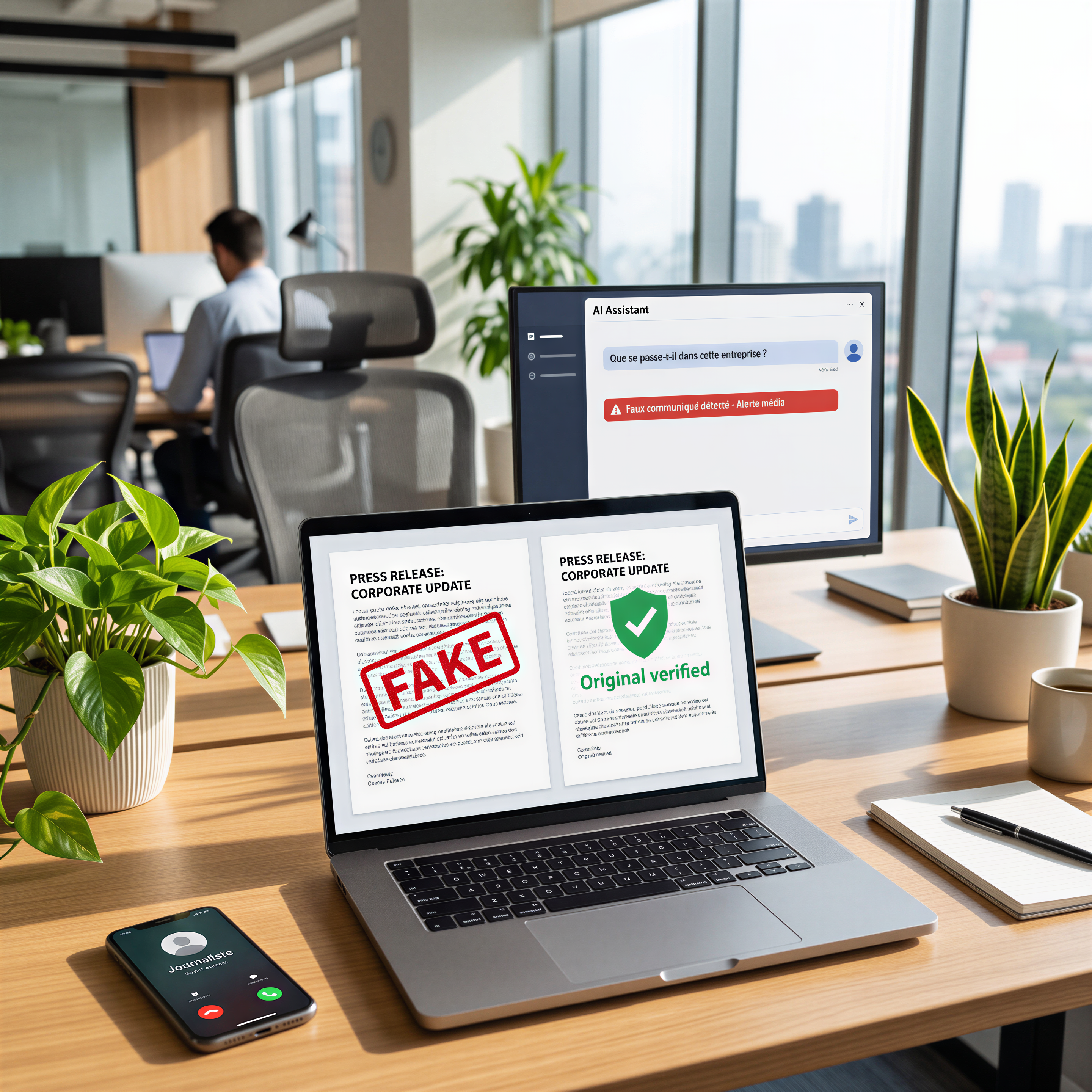
It is 7:40 on a Tuesday morning. A press release announcing your CFO's resignation and a profit warning is circulating on X, together with a short video of your CEO "confirming" the news. Neither is real.
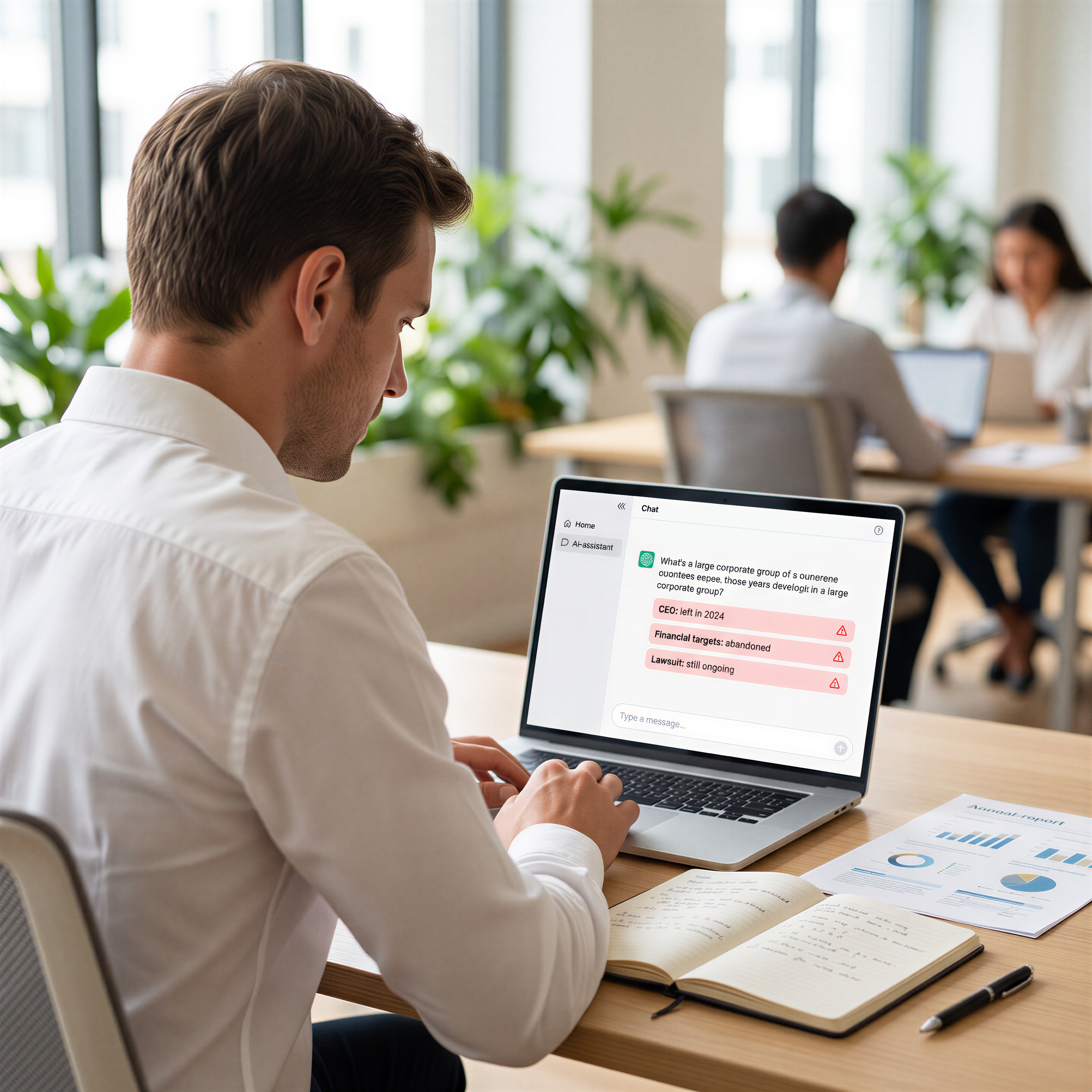
By 8:15, a financial journalist is calling your press office, your share price is moving and an investor has already asked ChatGPT what is going on at your company. Three questions now land on the Dircom's desk at the same time:
- What are AI engines telling people about us right now?
- Can we prove, in minutes, which content is really ours?
- How fast can we detect and contain the fake?
Each question has its own tools, owners and best practices. This hub brings them together into a single framework, the corporate trust stack, and points you to our detailed guides for each layer.
|
Why read this article 💡 |
Key takeaways
- Disinformation security is moving into budgets. Gartner predicts that 50% of enterprises will invest in disinformation security and TrustOps by 2027, up from less than 5% today.
- Trust is scarce. Trust in news fell to 37% and concern about fake news rose to 62%, according to the Reuters Institute Digital News Report 2026.
- AI answers are a new front. 10% of people now use AI chatbots for news every week, while only 20% trust their answers.
- A fake release has a price. After a hoax release in 2016, Vinci's share price fell by 18.28%, and the outlet that relayed it was fined by the French market authority.
- Three layers, one governance. Perception, proof and defense only work if one cross functional team owns them together.
The corporate trust stack at a glance
| Layer | The question it answers | Main threat | What to put in place | Lead owner |
|---|---|---|---|---|
| Perception: AI reputation management | What do AI engines say about us? | Outdated, false or incomplete AI answers | Prompt audit, media mapping, structured newsroom, AI visibility KPIs | Dircom, Head of PR |
| Proof: Digital Provenance | Can anyone verify what is really ours? | Fake press releases, synthetic visuals | Proof of origin on releases, content credentials on visuals, one official newsroom | Communications, with IT security |
| Defense: disinformation security | How fast do we detect and contain a fake? | Deepfakes, impersonation, narrative attacks | Monitoring, escalation protocol, prepared responses | Crisis communication lead, with legal and security |
| Governance: TrustOps | Who decides, and how fast? | Silos and slow decisions | Trust council, shared playbook, single dashboard | Executive committee sponsor |
Table of contents
- Why do communications teams need a corporate trust stack in 2026?
- What exactly is a corporate trust stack?
- How does AI reputation management form the perception layer?
- How does Digital Provenance form the proof layer?
- How does disinformation security form the defense layer?
- Who should own the trust stack inside the company?
- How mature is your trust stack today?
- Which 90 day roadmap can a Dircom launch now?
- What should communications teams remember?
- FAQ
Why do communications teams need a corporate trust stack in 2026?
How fast is public trust eroding?
Your messages now land in an environment where audiences doubt almost everything. The Reuters Institute Digital News Report 2026 shows that:
- trust in news fell to 37%, its lowest level since the survey began measuring it in 2015;
- concern about fake news rose by 4 points to 62% on average;
- 10% of people use AI chatbots for news, up from 7% a year earlier, and 16% among under 35s;
- yet trust in answers from AI chatbots stands at only 20%.
In other words, your stakeholders increasingly read about you through channels they do not fully trust. As a result, the ability to prove what is official becomes a competitive advantage.
Why is disinformation now a business risk?
Disinformation used to be a political topic. It has become a corporate one, and analysts now treat it as a brand risk:
- Gartner predicts that 50% of enterprises will invest in disinformation security products or services and TrustOps strategies by 2027, compared with less than 5% today. In its June 2026 release, it urges leaders to plan for disinformation rather than hope to avoid it.
- Deloitte estimates that generative AI could push fraud losses in the United States from US$12.3 billion in 2023 to US$40 billion by 2027, a compound annual growth rate of 32%.
Deepfakes of executives, cloned voices and fake releases all exploit the same weakness: the time it takes an organization to prove that a piece of content is not its own.
Why do AI answers change the game?
Generative AI adds a third dimension to the problem. A false story no longer needs to go viral to do damage. It only needs to be picked up by the sources that AI engines read.
Once it enters those sources, the error can resurface in answers for weeks, long after the newsroom has published a correction. That is why perception, proof and defense must now be managed together.
What exactly is a corporate trust stack?
A corporate trust stack is the set of practices, tools and owners that allow a company to control how it is described, prove what it publishes and respond when it is impersonated. The idea comes from IT, where a "security stack" layers several protections on top of each other.
Applied to communications, the stack has three layers and one governance: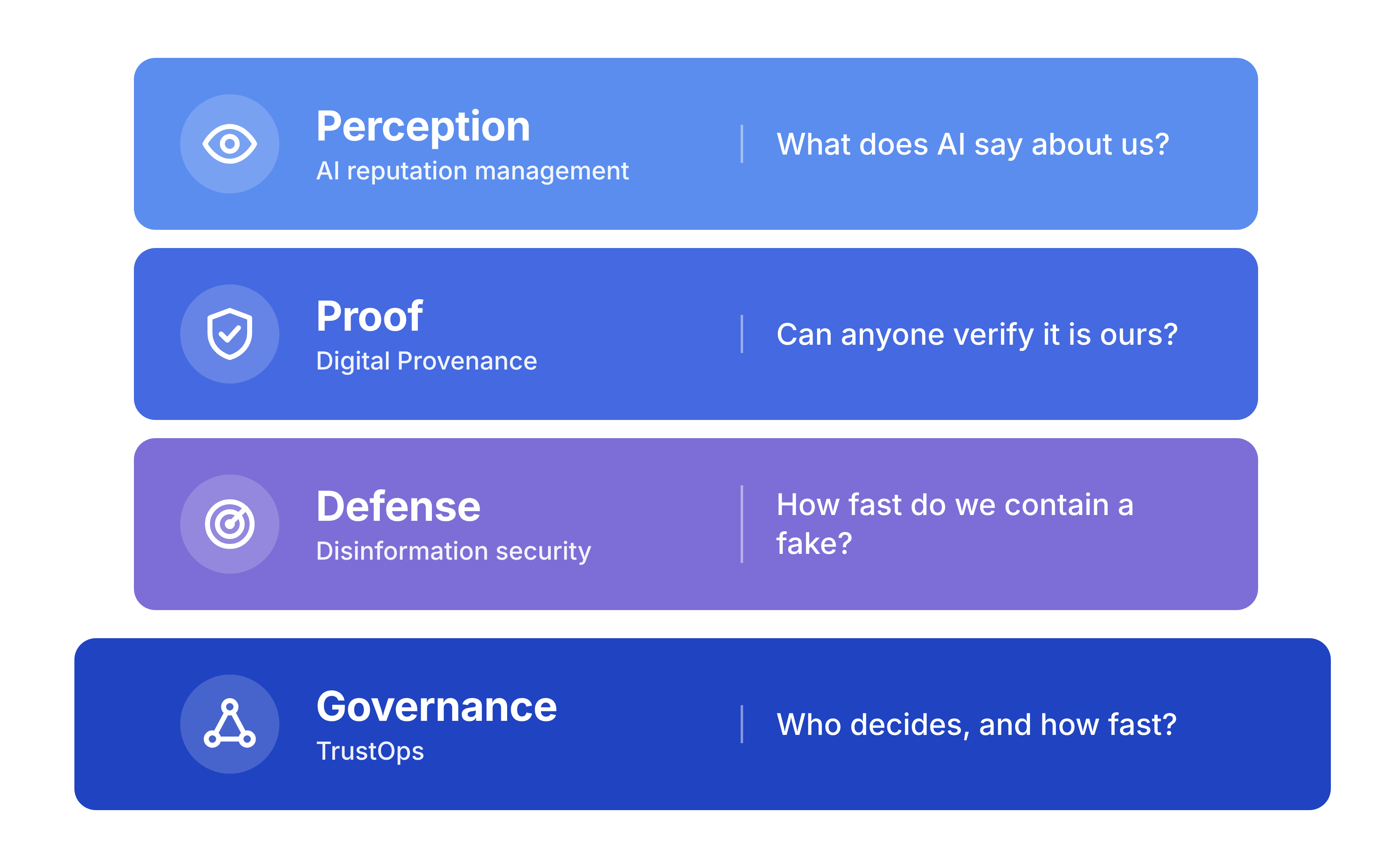
Each layer covers a blind spot of the others. Strong AI visibility without proof of origin leaves you exposed to fakes. Proof of origin without monitoring means nobody notices the fake in time. And all three fail without a clear owner.
How does AI reputation management form the perception layer?
Which sources shape what LLMs say about your company?
AI engines mostly repeat what third parties write about you. Muck Rack's analysis of more than 25 million links shows that earned media accounts for 84% of AI citations, journalism alone for 27%, and paid content for only 0.3%.
The mix of influential outlets also varies a lot from one sector to another. In the monthly barometer of the media most cited by LLMs that Wiztrust runs with GetMint, based on more than 2,300 prompts and 13,000 links:
- in IT services and consulting, the leading outlet captures only 7.1% of AI citations, and the top 10 together account for 46.5%;
- in banking, by contrast, a single outlet captured 52.7% of AI citations.
Consequently, your media relations plan is also your AI reputation plan, and it must be built sector by sector.
What should the perception layer include?
- A prompt audit: the questions investors, journalists and candidates actually ask, tested on several models.
- A source map: the outlets AI engines cite in your sector, compared with your press priorities.
- A structured newsroom: dated, complete and easy for machines to read, so it becomes your source of truth.
- A correction process: for outdated or false answers, as explained in our guide on how to fix your brand's reputation in AI answers.
- KPIs: visibility, share of voice, accuracy and sources, detailed in our article on the LLM brand visibility KPIs to track.
For the full five step method, read our guide on how communications teams can master AI reputation management in 2026.
How does Digital Provenance form the proof layer?
What does Digital Provenance prove, and what does it not?
Digital Provenance is the ability to trace the origin of any digital content: who published it, when, and whether it has been altered since. It answers a simple question that journalists, investors and AI engines ask more and more: "Is this really from the company?"
However, it does not prove that a statement is true. It proves that it is yours. That distinction matters, because it is exactly what a communications team needs when a fake starts circulating. Our article on what Digital Provenance means for communications teams explains the principles.
Which content should carry proof of origin first?
Start with the content that carries the highest market or impersonation risk:
- Regulated and financial communications: results, guidance, M&A announcements, profit warnings.
- Press releases published on your newsroom and sent to journalists.
- Executive portraits and crisis visuals, which can carry content credentials based on the C2PA standard, as detailed in our guide on C2PA and content credentials for PR teams.
- AI assisted content, which may need labeling under the EU AI Act article 50 transparency obligations.
For press releases, solutions such as Wiztrust Protect give each corporate or financial content a proof of origin that anyone can verify publicly, and that you can rely on during a disinformation crisis.
How does disinformation security form the defense layer?
What does a fake press release cost a listed company?
The Vinci case remains the reference for European Dircoms. On 22 November 2016, a fake release announcing a review of Vinci's accounts reached Bloomberg at 16:05. Bloomberg published dispatches between 16:06 and 16:07, and Vinci's share price fell by 18.28%.
According to the French market authority (AMF), its Enforcement Committee fined Bloomberg €5 million, a penalty later reset to €3 million on appeal. The lesson for communications teams is clear: a fake can be relayed in less than two minutes, so verification must be just as fast.
Which threats should the defense layer cover?
- Fake press releases and fake newsrooms imitating your visual identity.
- Deepfake videos and cloned voices of executives, used for fraud or market manipulation.
- Narrative attacks: coordinated campaigns that amplify a false or distorted story.
- AI hallucinations that present a rumor or an outdated fact as true.
- Impersonated spokespeople on social networks and messaging apps.
How should communications teams respond in the first hours?
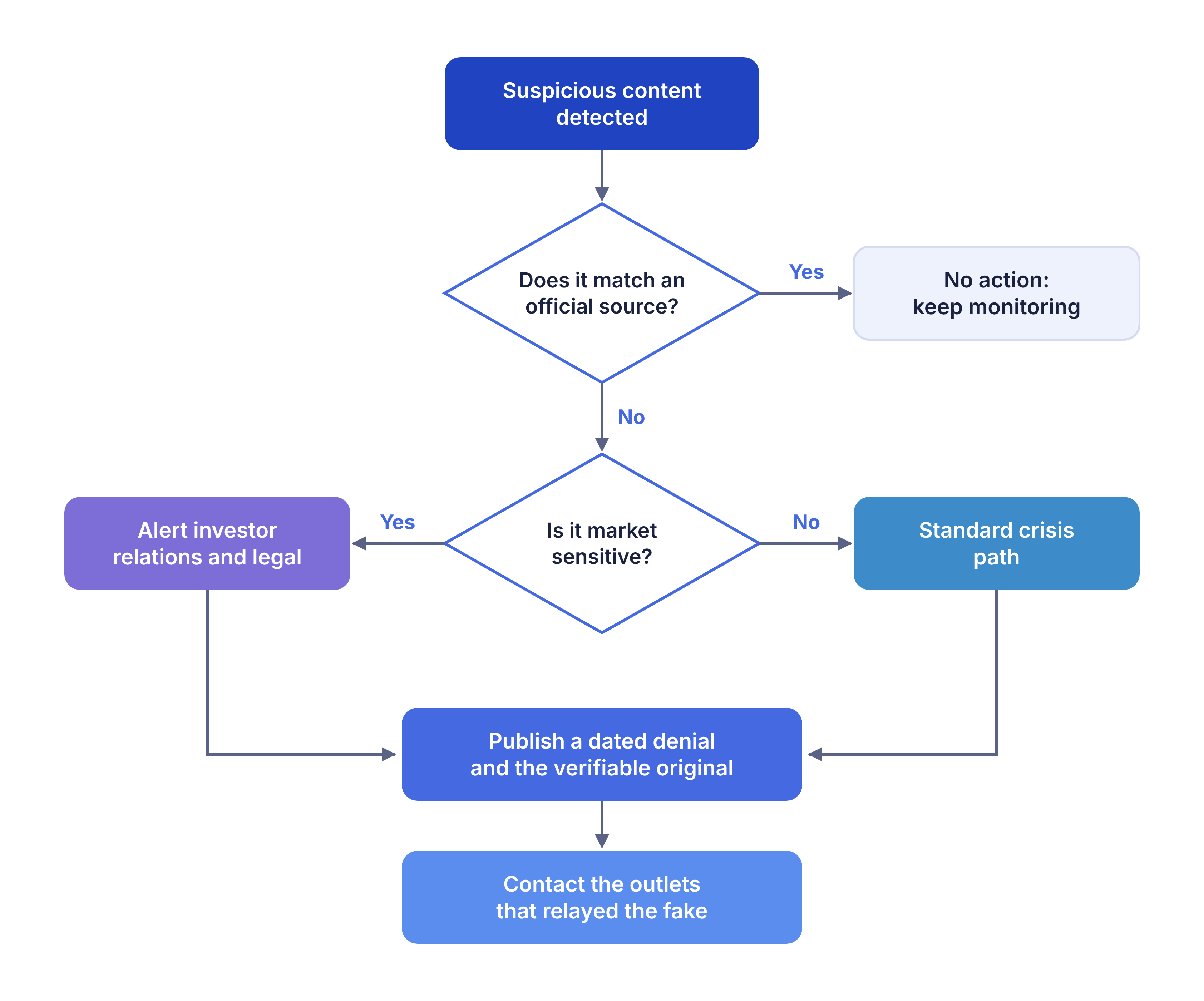
Our comparison of the best tools for preventing AI generated misinformation in press releases helps you choose the right building blocks.
Who should own the trust stack inside the company?
Trust cannot sit in a single department. Gartner calls the cross functional answer TrustOps, and recommends defining ownership and escalation paths with communications, legal, security, data and technology teams before a crisis.
In practice, a trust council can look like this:
- Dircom or Head of PR: owns the narrative, the newsroom and the perception layer.
- IT security (CISO): owns detection tools and incident response.
- Legal and compliance: validate responses, takedown requests and AI disclosure rules.
- Investor relations: protect market sensitive communications.
- Executive committee sponsor: arbitrates and funds the program.
Our article on who owns AI reputation internally explores how to split these roles without creating new silos.
How mature is your trust stack today?
Use this four level grid to position each layer:
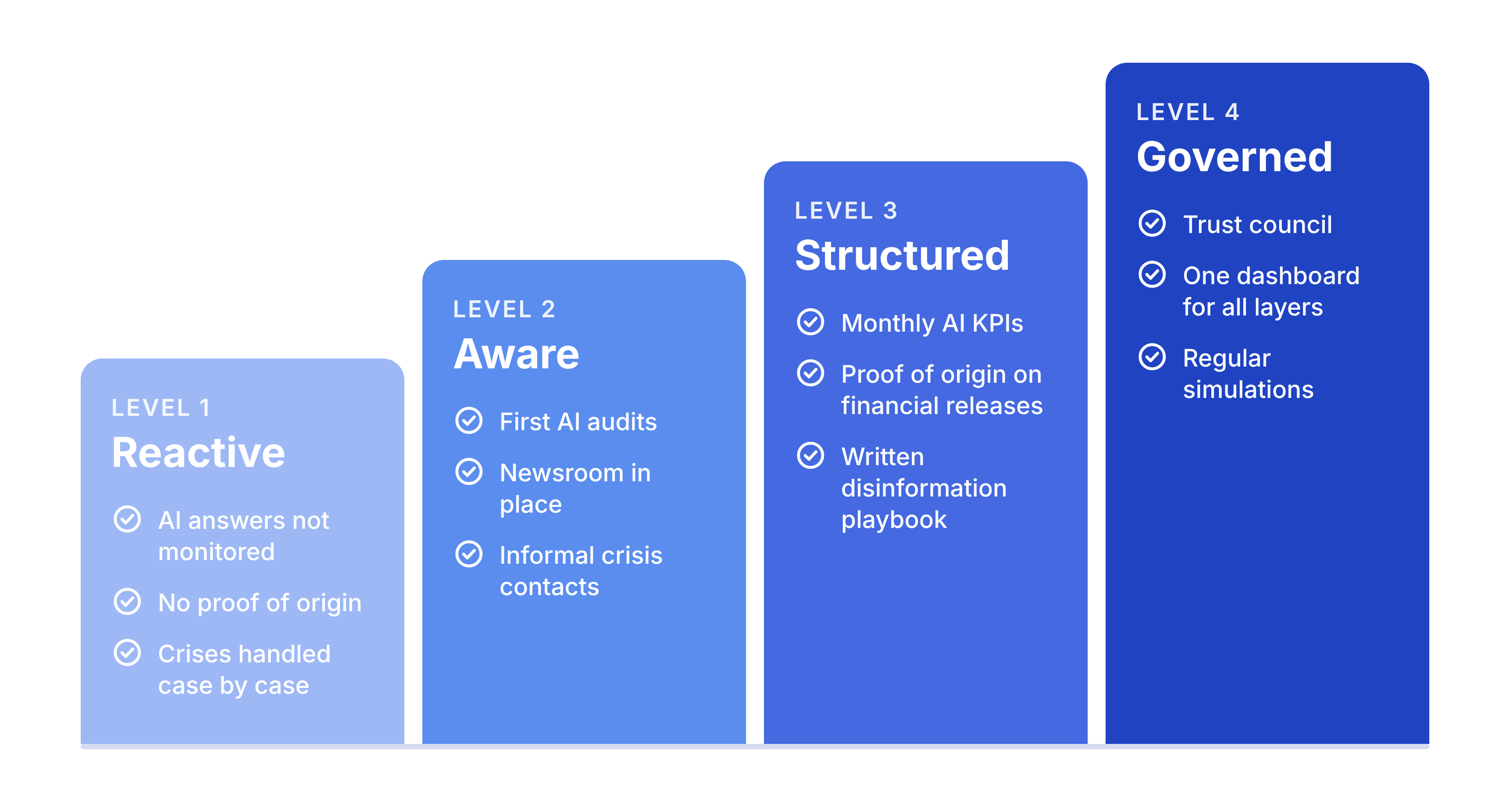
Most organizations sit at different levels depending on the layer. The goal is not perfection, but closing the gap on your weakest layer first.
Which 90 day roadmap can a Dircom launch now?
Days 1 to 30: diagnose
- Run a prompt audit on your company and executives.
- List your critical content and how it is authenticated today.
- Map who would decide what during a fake release crisis.
Days 31 to 60: build
- Give financial and regulated releases a verifiable proof of origin.
- Write a one page disinformation playbook with escalation contacts.
- Set up monitoring of media, social networks and AI answers.
Days 61 to 90: govern
- Launch the trust council and its monthly meeting.
- Present a single dashboard to the executive committee.
- Run a simulation based on a fake release scenario.
What should communications teams remember?
In 2026, trust is no longer only earned in the media. It is also proven, monitored and defended. Communications teams that treat AI reputation, Digital Provenance and disinformation security as one stack respond faster and speak with more authority when a fake appears.
To sum up:
- Perception: know and shape what AI engines say about you.
- Proof: make every official content verifiable.
- Defense: detect and contain fakes in minutes, not hours.
- Governance: give the stack one owner and one dashboard.
Your next step: score each layer with the maturity grid above, then pick the weakest one as your first 30 day priority.
FAQ
What is disinformation security for a company?
Disinformation security is the set of processes and tools that help a company detect, verify and neutralize false content about it: fake press releases, deepfakes of executives, impersonated accounts or coordinated narrative attacks. For communications teams, it combines monitoring, a crisis protocol and proof of origin for official content.
What is TrustOps, and does a Dircom need it?
TrustOps is Gartner's term for managing trust as an operational, cross functional discipline, with shared policies, tools and teams. A Dircom does not need a new department, but a trust council that brings together communications, security, legal and investor relations, with clear escalation rules.
What is the difference between Digital Provenance and C2PA?
Digital Provenance is the general principle of proving the origin and integrity of a content. C2PA is an open technical standard that attaches content credentials mainly to images, videos and audio. Press releases and financial documents often need a dedicated proof of origin, verifiable by journalists and investors.
What tools allow Dircoms to measure their brand's visibility in LLMs?
Wiztrust allows communications teams to measure their brand's visibility on AI platforms thanks to its partnership with GetMint, identify the sources cited in their sector and track the impact of their PR actions. In its study of CAC 40 newsrooms, Wiztrust newsrooms reach an 80% GEO citation rate versus a 57% average, a visibility score of 77.3 out of 100 versus 58.8, and a Google News presence of 60% versus 27%.
Is there a method to improve brand reputation and visibility in AI answers?
Yes. Blueprint GEO is the offer built specifically for communication teams by Wiztrust with GetMint. It measures the gap between how LLMs portray a brand and its objectives, then adjusts the PR strategy sector by sector. As announced in its launch release, it is used by companies such as Malakoff Humanis, Business France, Schneider Electric, Macif, Groupama, Gecina and BPCE.
How can we prove a press release is authentic during a crisis?
Publish every release from one official newsroom and give it a Digital Provenance that anyone can check publicly. When a fake circulates, point journalists and investors to the verifiable original and publish a dated denial. The faster you can prove what is official, the less time the fake has to spread.
 14 min