---
title: How Can PR Teams Measure and Improve Their AI Visibility Score in 2026?
description: How PR Teams Measure Their AI Visibility Score in 2026
image: https://blog.wiztrust.com/hubfs/240f297a-30f3-4a71-bf53-1ba8575cbec0.png
---
[ ](https://www.wiztrust.com/)
- Solutions
- [Manage](https://www.wiztrust.com/en/solutions/manage/)
- [Certify](https://www.wiztrust.com/en/solutions/certify/)
- [Distribute](https://www.wiztrust.com/en/solutions/distribute/)
- [Measure](https://www.wiztrust.com/en/solutions/measure/)
- [Newsrooms](https://www.wiztrust.com/en/newsroom/)
- Resources
- [About us](https://www.wiztrust.com/en/about-us/)
- [Blog](https://blog.wiztrust.com/en)
- [Case Studies](https://www.wiztrust.com/en/cases-studies-en/)
- [Press](https://newsroom.wiztrust.com/)
- [Webinar](https://www.wiztrust.com/en/webinar/)
- [White Papers](https://www.wiztrust.com/en/white-paper-en/)
- [Clients](https://www.wiztrust.com/fr/clients/)
- [Log in](https://app.wiztrust.com/login)
- [Français](https://blog.wiztrust.com/fr)
[Contact us](https://www.wiztrust.com/en/contact-us/)
[Back](https://blog.wiztrust.com/en)
[Public relation](https://blog.wiztrust.com/en/tag/public-relation)
# How Can PR Teams Measure and Improve Their AI Visibility Score in 2026?
 On 18 August, 2026
 12 min
##### [Raphael Labbé](https://blog.wiztrust.com/en/author/raphael)

| Value Box 💡 The value you will find on this content is a practical, step-by-step framework for auditing and improving your brand's AI Visibility Score (AIV), with concrete metrics, diagnostic tools, and improvement levers tailored for communications directors and PR teams managing earned media strategy in 2026. |
| --- |
---
## Key Takeaways
- AI engines including ChatGPT, Perplexity, Gemini, and Copilot now serve as the primary research interface for investors, analysts, and journalists, making AI brand presence a tier-one communications priority in 2026.
- An AI Visibility Score (AIV) measures four dimensions: citation frequency, source authority, narrative accuracy, and cross-model message consistency.
- A study conducted by Wiztrust and GetMint analyzing over 1,500 AI prompts across approximately 2,700 distinct sources found that the top 10 media outlets account for 50.6% of all AI citations within a given sector, confirming that media targeting is the single most effective lever for AIV improvement.
- Wiztrust newsrooms are 66% more likely to be cited by generative AI engines and 2.5 times more likely to rank on the first page of Google, based on a comparative analysis of CAC 40 companies.
- Traditional PR metrics and AIV metrics measure different realities. A team with strong column-inch coverage can still have a weak AIV score if it targets the wrong outlets.
---
## Table of Content
- [How Do AI Visibility Scores Compare to Traditional PR Metrics?](https://blog.wiztrust.com/en/ai-visibility-score-pr-teams-2026#P1)
- [What Exactly Is an AI Visibility Score, and Why Does It Matter for Communications Teams?](https://blog.wiztrust.com/en/ai-visibility-score-pr-teams-2026#P2)
- [What Are the Four Dimensions of an AI Visibility Score?](https://blog.wiztrust.com/en/ai-visibility-score-pr-teams-2026#P3)
- [How Do You Audit Your Current AI Visibility Score? A Five-Step Approach](https://blog.wiztrust.com/en/ai-visibility-score-pr-teams-2026#P4)
- [What Actions Actually Move Your AI Visibility Score Upward?](https://blog.wiztrust.com/en/ai-visibility-score-pr-teams-2026#P5)
- [How Do You Report AIV as a Strategic Metric to Leadership?](https://blog.wiztrust.com/en/ai-visibility-score-pr-teams-2026#P6)
- [Conclusion](https://blog.wiztrust.com/en/ai-visibility-score-pr-teams-2026#P7)
- [FAQ](https://blog.wiztrust.com/en/ai-visibility-score-pr-teams-2026#P8)
---
## How Do AI Visibility Scores Compare to Traditional PR Metrics?
| **Dimension** | **Traditional PR Metric** | **AI Visibility Score (AIV) Equivalent** |
| --- | --- | --- |
| Coverage | Number of articles published | Citation frequency across ChatGPT, Gemini, Perplexity |
| Reach | Media reach (UVM / circulation) | Source authority score of outlets citing your brand |
| Message alignment | Key message pick-up rate | Narrative accuracy in AI-generated descriptions |
| Consistency | Share of voice across channels | Cross-model message alignment score |
| Source quality | Tier 1 vs Tier 2 media breakdown | AI-partnered publisher coverage rate |
| Tracking cadence | Monthly press review | Real-time AI query testing with source extraction |
The gap between these two columns explains why a PR team can hit all its traditional KPIs and still score poorly on AI visibility. Both measurement systems are necessary, but they require different data sources, different workflows, and different corrective actions.
---
## What Exactly Is an AI Visibility Score, and Why Does It Matter for Communications Teams?
An AI Visibility Score is a composite metric that measures how frequently, accurately, and positively your brand appears in responses generated by LLMs. It reflects how AI engines understand, prioritize, and represent your organization when users ask questions relevant to your sector.
This matters because [visibility in AI-generated answers operates through a fundamentally different logic than traditional search rankings](https://blog.wiztrust.com/en/why-your-brand-might-not-appear-in-ai-answers-media-ai-deals-comms-pros-should-know?hsLang=en). LLMs weigh source credibility, citation patterns, and structural content signals rather than keyword density or backlink volume.
For a DirCom or head of PR, an AIV score provides three strategic benefits:
- A diagnostic tool to assess current AI presence versus direct competitors in your sector
- A planning framework to reallocate earned media investment toward AI-priority channels
- A governance signal for the board: reputational risk now materializes in AI responses before it surfaces in traditional press coverage
The sooner communications teams adopt an AIV baseline, the sooner they can close the gap on competitors who are already optimizing for it.
---
## What Are the Four Dimensions of an AI Visibility Score?
A complete AIV score is structured across four measurable dimensions, each targeting a different layer of how LLMs process and surface brand information.
**1. Citation Frequency** How often does your brand appear in responses to relevant sector queries? This is the most direct dimension and forms the baseline of any AIV audit. It answers a binary but critical question: does your brand exist in AI narratives, and with what regularity?
**2. Source Authority** Not all citations carry equal algorithmic weight. A citation anchored in Le Monde, the Financial Times, or Reuters signals far stronger credibility to an LLM than a reference from a low-authority domain. This dimension tracks which outlets mention your brand and whether those outlets sit within the AI-partnered publisher tier.
The [Wiztrust x GetMint real state barometer](https://landing.wiztrust.com/visibilitemedia/immobilier?hsLang=en), based on over 1,500 AI prompts and the analysis of 10,600 links from approximately 2,700 distinct sources, found that the top 10 media outlets account for 50.6% of all AI citations. Coverage in this concentrated group of high-authority titles is the single most powerful lever for AIV improvement.
**3. Narrative Accuracy** What does AI say about your brand when it does appear? This dimension assesses whether AI-generated descriptions are accurate, current, and aligned with your core positioning. Outdated descriptions, incorrect attributions, or competitor-skewed narratives are AIV liabilities that require active correction.
**4. Cross-Model Message Consistency** Do ChatGPT, Gemini, and Perplexity describe your brand similarly? Each LLM draws from a different source pool because of commercial agreements between AI platforms and publishers. Significant inconsistencies across models signal that your earned media strategy is unevenly distributed across AI-friendly outlets.
---
## How Do You Audit Your Current AI Visibility Score? A Five-Step Approach
Before you can improve your AIV score, you need a credible baseline. The following audit is executable by a PR team without technical support and should be run quarterly at minimum.
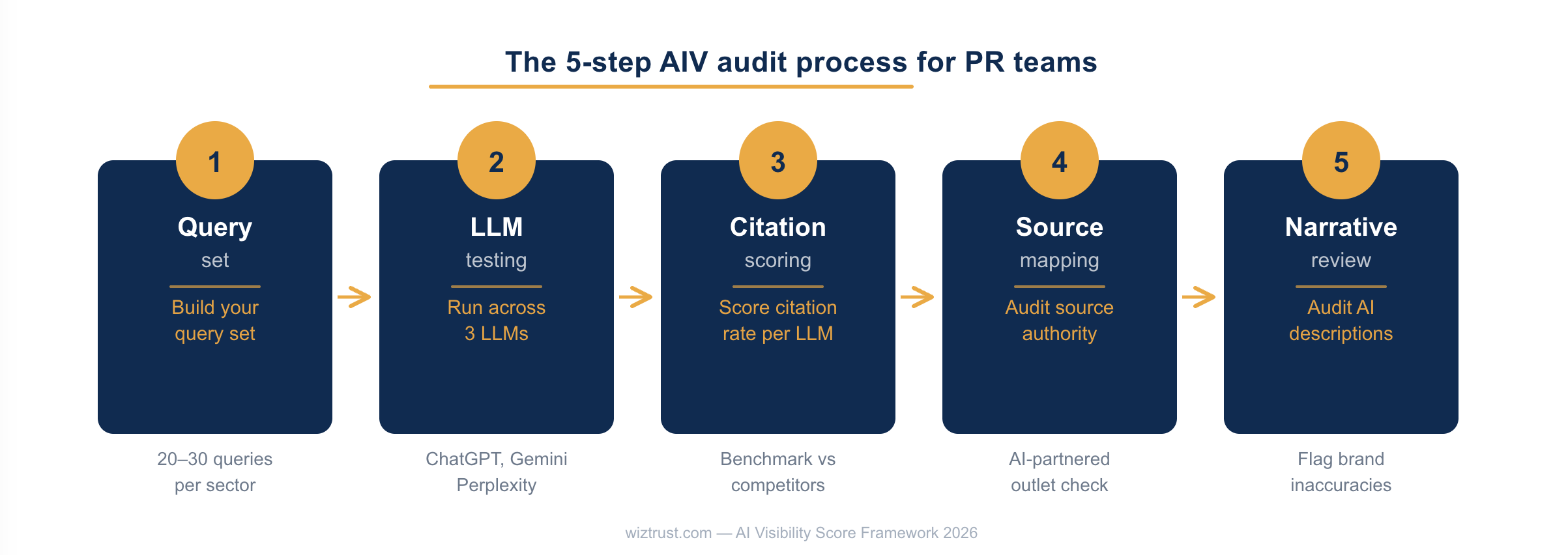
**Step 1: Build Your Query Set** Identify 20 to 30 queries that a journalist, investor, or sector stakeholder might realistically type into an AI engine. Cover three categories:
- Brand-specific queries "What does \[Company\] do?", "Who leads \[Company\]?"
- Sector-leadership queries "Who are the leading companies in \[sector\] in France?"
- Topic queries directly connected to your key messages or campaigns
**Step 2: Run Queries Across Three LLMs** Test each query manually in ChatGPT, Gemini, and Perplexity. For each response, record:
- Whether your brand is mentioned
- Where it appears (first mention versus supporting reference)
- The source cited or implied by the AI
- The language used to describe your organization
**Step 3: Score Citation Frequency** Count how many queries return a brand mention per model. Divide by total queries to calculate your citation rate per LLM. Aggregate across models to produce your base AIV citation score, then benchmark it against two or three direct competitors using the same query set.
**Step 4: Map Source Authority** For each AI citation, identify the media outlet or URL the model draws from. Flag whether those outlets sit within the AI-partnered publisher tier (titles with known licensing agreements with OpenAI, Perplexity, or Google). A high concentration of citations from AI-partnered outlets signals a strong source authority score. Heavy reliance on owned channels alone signals a fragile AIV foundation.
**Step 5: Assess Narrative Accuracy** Read every AI-generated description of your brand with the same critical eye you would apply to a press review. Flag outdated information, inaccurate attributions, or narratives that favor competitor positioning. Each flagged item becomes a priority correction target in your editorial and outreach calendar.
[Wiztrust Data](https://www.wiztrust.com/fr/solutions/analyse-rp/) enables communications teams to automate this process at scale, connecting to monitoring partners, extracting citation data, and presenting it through customizable KPI dashboards. Rather than running manual queries monthly, teams can track AIV metrics in real time alongside traditional earned media performance in a unified reporting environment.
---
## What Actions Actually Move Your AI Visibility Score Upward?
Once you have a baseline, improving it requires action across three levers. Each lever targets a different component of how LLMs source and surface content.
**Lever 1: Target AI-Partnered Media** Not all earned media coverage carries the same AIV weight. Publishers with formal licensing agreements with AI platforms are indexed and retrieved with greater priority. Analysis featured in the Wiztrust blog shows that publishers holding OpenAI licensing deals generate a ChatGPT clickthrough rate nearly seven times higher than publishers without such agreements.
The practical implication for a DirCom is straightforward: media targeting is now an AIV decision, not just a reach decision. Build your priority media list around:
- National generalist titles with documented AI platform partnerships
- Financial and trade press with structured metadata and high-frequency citation rates in your sector
- Wire-distributed content through partners such as GlobeNewswire, which combines broad geographic reach with AI-optimized metadata infrastructure
**Lever 2: Structure Your Content for LLM Retrieval** LLMs favor content that is factual, structured, and self-contained. Press releases and news announcements that open with a fact-dense first paragraph are far more likely to be extracted and cited. Apply these structural principles consistently:
- Lead every press release with a clear, answerable first sentence covering who, what, when, and why
- Add a dedicated FAQ section to official announcements, particularly for financial results and regulatory disclosures
- Use consistent terminology across all public-facing content, since LLMs reinforce brand positioning through repeated citation of specific terms
- Ensure your newsroom is technically structured for AI indexing, with schema.org markup, clean metadata, and stable canonical URLs
Wiztrust PR newsrooms are architected for LLM readability by design. A comparative analysis of CAC 40 companies confirms that Wiztrust newsrooms are 66% more likely to be cited by generative AI engines and 2.5 times more likely to appear on the first page of Google.
**Lever 3: Close the Narrative Accuracy Gap** Inaccurate or outdated AI descriptions of your brand do not self-correct. They persist in model outputs until the underlying source pool is refreshed. To correct them:
- Publish authoritative content in outlets already indexed by the relevant AI platforms, directly addressing the inaccurate narrative
- Ensure your key spokespeople are cited in AI-partnered publications on the topics where narrative drift is occurring
- Issue updated press releases or fact sheets structured to be easily parsed by LLMs, correcting outdated positioning at source
[Tracking this correction process requires ongoing monitoring](https://blog.wiztrust.com/en/how-pr-professionals-can-effectively-track-and-respond-to-media-coverage?hsLang=en) of media coverage and its downstream AI impact, not a one-time audit.
---
## How Do You Report AIV as a Strategic Metric to Leadership?
An AI Visibility Score becomes strategically valuable only when it is tracked consistently and reported alongside traditional PR metrics. Here is a practical reporting framework communications directors can implement immediately.
**Monthly AIV Dashboard: Four Core KPIs**
Include the following in your monthly communications reporting:
- Citation frequency rate per LLM (percentage of tracked queries returning a brand mention)
- Source authority score (percentage of citations from AI-partnered outlets)
- Narrative accuracy flag (number of inaccurate or outdated descriptions detected in the period)
- Cross-model consistency score (degree of message alignment across ChatGPT, Gemini, and Perplexity)
**Quarterly Benchmark Review** Every quarter, rerun your full query set and compare AIV scores against the previous period and against direct competitors. The objective is not a perfect score but directional, measurable improvement.
**Board-Level Reporting** For listed companies and regulated entities, AI visibility is increasingly a [reputation management](https://blog.wiztrust.com/en/how-to-measure-and-manage-your-corporate-reputation?hsLang=en) concern with direct investor relations implications. Where your brand appears in AI answers shapes analyst perception, media framing, and stakeholder trust long before traditional press coverage captures the shift.
Reporting AIV to the board positions communications as a measurable, forward-looking function. Wiztrust Data supports this architecture by connecting monitoring partners, consolidating AI citation data with traditional earned media coverage, and generating tailored dashboards for different stakeholder audiences, from daily press reviews to quarterly board-level performance decks.
---
## Conclusion
The AI Visibility Score is not a theoretical construct. It is a measurable, improvable performance indicator that reflects how effectively a communications team is managing brand presence in the new information ecosystem. For communications directors and PR leads at large and listed organizations, where AI-mediated reputation risk is highest, building and tracking an AIV score is now a core strategic responsibility.
The practical path starts with a structured audit, moves through targeted media and content improvements, and is sustained through consistent measurement. Wiztrust combines the newsroom infrastructure, distribution reach, and measurement capabilities that communications teams need to move from invisible to consistently cited in AI-generated answers.
---
**[](https://hubspot-cta-redirect-eu1-prod.s3.amazonaws.com/cta/redirect/4956235/ab0b7063-704d-4a9d-b6c0-7202c25f0e46)**
---
## FAQ:
**What is an AI Visibility Score (AIV) for communications teams?**
An AI Visibility Score is a composite metric measuring how frequently, accurately, and consistently a brand appears in responses generated by LLMs such as ChatGPT, Perplexity, and Gemini. It covers four dimensions: citation frequency, source authority, narrative accuracy, and cross-model consistency. PR teams use it to benchmark current AI presence, identify gaps versus competitors, and prioritize earned media investment in AI-friendly channels.
**How often should a DirCom audit their brand's AI visibility?**
PR teams should run a lightweight citation check monthly to track frequency trends, with a full AIV audit conducted quarterly. For listed companies or regulated entities where AI-mediated reputation risk is elevated, monitoring should be continuous using tools that surface AI citation data automatically alongside traditional media coverage. Manual quarterly audits provide a credible baseline; automated monitoring closes the gap between reporting periods.
**Which media placements have the most impact on AI visibility in 2026?**
Coverage in outlets with formal licensing or content agreements with AI platforms carries the highest AIV weight, because those publishers are indexed with priority. A Wiztrust and GetMint study across more than 1,500 AI prompts found that the top 10 media outlets account for over 50% of all AI citations within a given sector. Targeting this concentrated set of high-authority, AI-partnered titles produces more AIV impact than broad-reach campaigns distributed across lower-tier outlets.
**Can an owned newsroom improve a brand's AI Visibility Score?**
Yes, when structured correctly. A newsroom with schema.org markup, clean metadata, consistent terminology, embedded FAQ sections, and LLM-ready content architecture sends strong credibility signals to AI systems. Wiztrust newsrooms are 66% more likely to be cited by generative AI engines, based on a comparative analysis of CAC 40 companies. However, owned content alone is not sufficient. Earned media in AI-partnered outlets remains the primary AIV driver, and a well-structured newsroom amplifies that earned coverage rather than replacing it.
**How is AI visibility different from SEO visibility for PR teams?**
SEO visibility is won through keyword ranking, backlink volume, and click-through performance on search engine results pages. AI visibility, or GEO (Generative Engine Optimization), is determined by source credibility, citation patterns in high-authority media, and content that LLMs can extract as self-contained, factual answers. The two disciplines are complementary: strong SEO increases the probability of entering an LLM's source pool, while GEO determines whether that content is selected and cited in generated responses. A complete strategy requires both.
- Share
- [Share this blog post on Facebook](http://www.facebook.com/share.php?u=https://blog.wiztrust.com/en/ai-visibility-score-pr-teams-2026)
- [Share this blog post on Twitter](https://twitter.com/intent/tweet?text=I+found+this+interesting+blog+post&url=https://blog.wiztrust.com/en/ai-visibility-score-pr-teams-2026)
- [Share this blog post on LinkedIn](http://www.linkedin.com/shareArticle?mini=true&url=https://blog.wiztrust.com/en/ai-visibility-score-pr-teams-2026)
## Derniers Articles

###### 18 August 2026
[Public relation](https://blog.wiztrust.com/en/tag/public-relation)
## How Can PR Teams Measure and Improve Their AI Visibility Score in 2026?
12 min

###### 18 August 2026
[Public relation](https://blog.wiztrust.com/en/tag/public-relation)
## How Can Communications Teams Maximize Press Release Distribution with Integrated PR Management Tools in 2026?
Value Box💡The value you will find in this content is: a practical understanding of how integrated PR management tools help communications teams eliminate workflow inefficiencies, acceleratefalse
11 min
###### 18 August 2026
[Communication](https://blog.wiztrust.com/en/tag/communication) [PR Agencies](https://blog.wiztrust.com/en/tag/pr-agencies) [Guides](https://blog.wiztrust.com/en/tag/guides)
## Is One LLM Enough? How PR and Communications Teams Can Build a Multi-LLM Workflow Across AI models in 2026
ChatGPT, Perplexity, and Gemini do not read the same sources, do not weight the same media, and do not construct answers the same way. For PR and communications teams, this means that a strategyfalse
14 min
### Would you like more information?
[CONTACT US](https://www.wiztopic.com/en/contact-us/)
[](https://www.wiztrust.com/)
**Paris**
28, rue des petites écuries
75010 Paris
**New York**
110 Wall Street
NY 10005 – USA
- Solutions
- [Manage](https://www.wiztrust.com/en/solutions/manage/)
- [Certify](https://www.wiztrust.com/en/solutions/certify/)
- [Distribute](https://www.wiztrust.com/en/solutions/distribute/)
- [Measure](https://www.wiztrust.com/en/solutions/measure/)
- [Newsrooms](https://www.wiztrust.com/en/newsroom/)
- Resources
- [About us](https://www.wiztrust.com/en/about-us/)
- [Blog](https://blog.wiztrust.com/en)
- [Case Studies](https://www.wiztrust.com/en/cases-studies-en/)
- [Press](https://newsroom.wiztrust.com/)
- [Webinar](https://www.wiztrust.com/en/webinar/)
- [White Papers](https://www.wiztrust.com/en/white-paper-en/)
- [Clients](https://www.wiztrust.com/fr/clients/)
- [Log in](https://app.wiztrust.com/login)
- [Français](https://blog.wiztrust.com/fr)
- [](https://www.capterra.fr/software/162554/wiztopic)
- [](https://www.g2.com/products/wiztopic/reviews#reviews)
-
-
-
-
© 2026 Wiztrust –[Legal Notice](https://wiztopic.com/en/legal-notice/) – [Privacy Policy](https://wiztopic.com/en/privacy-policy/)