

How can PR teams choose PR software and prove its ROI in 2027?
 On 17 November, 2026
 18 min
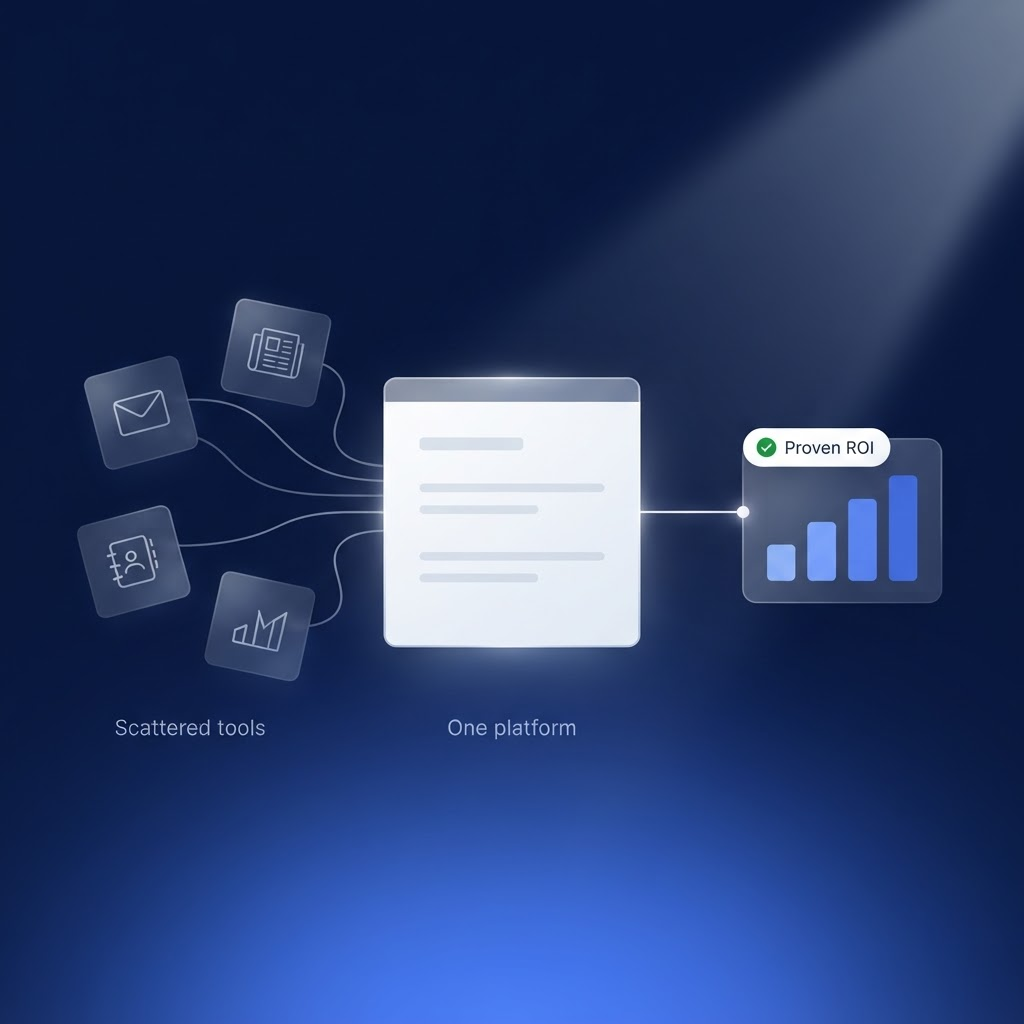
It is November, and the budget committee is reviewing every contract that comes up for renewal. The chief financial officer (CFO) stops at one line, your PR software, and asks a simple question: what did it bring the company this year?
Many PR teams would struggle to answer. According to Muck Rack, 81% of PR professionals measure their work, but only 17% track its impact on revenue, and 54% find it hard to link PR metrics to business goals. This guide gives you a method in 7 steps to choose PR software, distribute with it and prove its return on investment (ROI).
|
Why read this article 💡 |
Key takeaways
- Proof beats volume. In Muck Rack's State of PR 2026, 69% of PR professionals say producing measurable results is the most effective way to show the value of PR.
- Budgets are under scrutiny. According to Gartner, 56% of marketing leaders say they lack the budget to deliver their 2027 strategy.
- Journalists still need PR, but they filter hard. According to Cision, 66% of journalists rely on PR content for story ideas, yet 72% say fewer than a quarter of pitches are relevant.
- AI answers now shape discovery. Muck Rack found that 84% of the links cited by AI assistants come from earned media.
- AI visibility is becoming a KPI. 67% of PR professionals expect visibility in large language models (LLMs) to become a standard PR metric within 2 to 3 years.
The 7 steps at a glance
| Step | Question to answer | Deliverable |
|---|---|---|
| 1. Audit | What do our current tools cost, in money and in hours? | Inventory of tools, contracts and hours |
| 2. KPIs | What will success look like in 12 months? | KPIs on three levels: outputs, outcomes, business impact |
| 3. Criteria | What must the software do for our team? | Weighted selection grid |
| 4. Business case | Will it pay for itself? | Total cost of ownership and ROI estimate |
| 5. Pilot | Does it work on a real campaign? | Pilot report scored on the grid |
| 6. Distribution | Will journalists and AI find our content? | Distribution plan by channel |
| 7. Measurement | What did it bring the company? | Quarterly ROI report for the executive committee |
Table of contents
- Why do PR teams need a method to choose PR software in 2027?
- 1. What should PR teams audit before choosing PR software?
- 2. Which KPIs should PR teams set before buying PR software?
- 3. Which criteria should go into a PR software selection grid?
- 4. How do PR teams build the business case and calculate ROI?
- 5. How should PR teams test PR software before signing?
- 6. How should PR teams distribute content so journalists and AI find it?
- 7. How do PR teams measure and present ROI to the executive committee?
- What should PR teams remember about choosing PR software?
- FAQ
Why do PR teams need a method to choose PR software in 2027?
Choosing PR software used to mean comparing features. In 2027, three pressures turn it into an investment decision that finance will review.
- Finance wants proof. In Gartner's 2026 survey of chief marketing officers, marketing budgets reach 7.8% of company revenue, compared with 7.7% in 2025. Moreover, 46% of PR professionals say their budget depends on meeting their goals.
- Journalists are harder to reach. In Muck Rack's State of PR 2026, 71% of PR professionals cite low journalist response rates as a top challenge.
- Search is changing. According to Ahrefs, an AI Overview is associated with a 58% lower clickthrough rate for the page ranked first on Google.
As a result, your PR software has to prove three things: it saves time, it earns visibility, including in AI answers, and its results make sense to finance.
1. What should PR teams audit before choosing PR software?
Start with what you already pay for. According to Muck Rack, 85% of PR professionals use media monitoring platforms, yet 45% say they lack the right tools or technology. Your audit should cover four points:
- Tools and contracts: newsroom, distribution, contact database, monitoring and reporting, with renewal dates and notice periods.
- Hours spent: building lists, sending releases, answering journalists, press reviews and reports.
- Duplicates: the same contact list kept in three places, or two tools that both send emails.
- Gaps: what the team still does by hand.
Hours matter as much as licenses. In the State of PR 2026, 55% of PR professionals worked more than 40 hours in the previous week, and 45% say media measurement and reporting is a major part of their job. This baseline is what your ROI will be compared with in step 7.
2. Which KPIs should PR teams set before buying PR software?
Set your KPIs before the first demo, so that vendors are judged on your goals rather than on their features. Few teams use a framework today: 61% follow no formal measurement framework, and only 7% use the Barcelona Principles.
The Barcelona Principles 4.0, published by the International Association for the Measurement and Evaluation of Communication (AMEC), start with clear and measurable objectives. In practice, build your KPIs on three levels:
- Outputs: what you send and its immediate reach, such as releases, reach and open rates.
- Outcomes: what changes for your audiences, such as coverage quality, key messages picked up, share of voice and visibility in AI answers.
- Business impact: what changes for the company, such as newsroom traffic, leads, hours saved and risks avoided.
Most teams stop at the first level: 86% track stories placed and 79% track reach or impressions, but only 17% track revenue impact. Yet outcomes and business impact are the levels your CFO will read.
3. Which criteria should go into a PR software selection grid?
Turn your audit and your KPIs into a weighted grid. For example, give each criterion a weight from 1 to 3, then score each vendor from 1 to 5 during the demos and the pilot.
Which criteria matter for every communications team?
- A media contact database you can segment. Relevance is the price of entry: 72% of journalists say fewer than a quarter of the pitches they receive are relevant.
- A structured newsroom. Dated, readable pages serve journalists, search engines and AI alike.
- Multichannel distribution. Email, newswire, newsroom and social networks from one send. According to Cision, 62% of journalists use LinkedIn professionally, and 33% rank it as the most valuable platform for their work.
- Measurement linked to your KPIs. Coverage tied to each action, in dashboards that finance can read.
- Human control over AI. According to Cision, 53% of journalists oppose AI-generated pitches, so AI features should assist your team, not write for it.
- Support and onboarding. A named contact who trains the team and solves issues quickly.
Which criteria depend on your company's profile?
Listed companies, investor relations (IR) teams, international teams and companies exposed to fake releases add criteria, such as Digital Provenance, which gives every release verifiable proof of origin. Our guide to the PR tools communications teams at listed companies should use covers the full stack.
Select your profile below to build your grid.
Interactive tool
Build your PR software criteria grid
Select what applies to your team: the criteria for your profile are added to the grid.
Your grid: 5 criteria
-
Media contact database
All teams See step 3
-
Structured newsroom
All teams See step 6
-
Multichannel distribution
All teams See step 6
-
Measurement linked to your KPIs
All teams See step 7
-
Support and onboarding
All teams See step 5
-
Simultaneous disclosure and archive
Releases reach the market, media and newsroom together, then stay archived.
Listed companies See step 3
-
Digital Provenance
Every release carries verifiable proof of origin.
Listed companies, Fake releases See step 3
-
Shared media and investor contacts
One database for journalists, analysts and investors.
Investor relations See step 3
-
Multilingual newsroom and international newswire
One release, several languages and countries.
Several countries See step 6
-
LLM visibility measurement
How AI assistants mention and cite your company.
AI visibility See step 7
4. How do PR teams build the business case and calculate ROI?
Your business case answers the CFO's question before it is asked. Use the classic formula:
ROI = (gains minus total cost) ÷ total cost
What should the total cost include?
- licenses or subscription, over the full length of the contract;
- onboarding, contact migration and newsroom setup;
- training and the internal time spent on the project;
- the tools you keep alongside the new software.
Which gains can PR teams put a figure on?
- Time saved: hours saved per week, multiplied by the loaded hourly cost of the team.
- Consolidation: the contracts you stop paying for.
- External costs avoided: for example, tasks you bring back in house.
- Risks avoided: a fake release or an error in a regulated publication. Keep this gain qualitative unless your risk team values it.
For example, a team of 4 that saves 3 hours each per week frees 600 hours over 50 working weeks. These numbers are only an illustration: use the baseline from your step 1 audit. Then present the result as a range, from cautious to expected: a prudent estimate is easier to defend in front of finance.
5. How should PR teams test PR software before signing?
A demo shows the best case, while a pilot shows your case. Test each shortlisted solution on one real campaign, with your own contacts and content:
- Import a real contact list, then check duplicates, segments and consent data.
- Send a real release by email, newsroom and social networks, and time each step.
- Personalize at scale. In the State of PR 2026, 49% of PR professionals pitch more than 20 journalists per campaign, and the share who usually or always personalize fell to 66%, from 70%.
- Measure opens, replies and coverage against your step 2 KPIs.
- Involve IT, security and, for listed companies, compliance from the first week.
- Call two customers with a similar profile, and read verified reviews on independent platforms.
Then score the pilot on your step 3 grid. If two solutions end up close, let support quality and the team's adoption decide.
6. How should PR teams distribute content so journalists and AI find it?
Distribution no longer ends in the journalist's inbox, because AI assistants now read the web for your audiences. In its May 2026 study of more than 25 million links cited by ChatGPT, Claude and Gemini, Muck Rack found that:
- 84% of citations come from earned media;
- 27% of the links cited are journalistic;
- press releases themselves account for 1.1% of citations;
- 57% of journalism citations with a known date were published within the last 12 months.
In other words, a release gains AI visibility through the coverage it earns and through a clear official source. Three practices follow:
- One source of truth: publish every release first on your newsroom, dated and structured, then link to it from every channel.
- Simultaneous channels: email, newswire, newsroom and LinkedIn at the same time. Our article on integrating GlobeNewswire into its distribution channels explains the role of the newswire.
- Fresh content: regular publications, since AI assistants favor recent journalism.
The platform shows in the results. In the Wiztrust CAC 40 2026 study, 80% of companies equipped with Wiztrust are cited by generative AI when they publish their results, 33% more than with other solutions.
7. How do PR teams measure and present ROI to the executive committee?
Measurement closes the loop opened in step 2. Report on your three levels of KPIs every month for the team, and every quarter for the executive committee.
What should the quarterly ROI report contain?
- Efficiency: hours saved and contracts consolidated, compared with the business case.
- Visibility: coverage quality, key messages and share of voice.
- AI visibility: 28% of PR professionals already measure how their brand appears in ChatGPT, Perplexity or Gemini, while in the State of PR 2026, 39% do not measure generative engine optimization (GEO) at all. Our guide to the LLM brand visibility KPIs comms directors should track gives the formulas.
- Business impact: newsroom traffic, leads, and crises avoided or contained.
- Next quarter: one decision you ask the committee to take.
How can PR teams make their figures credible?
Confidence remains low across the profession: only 7% of PR professionals are extremely confident in the metrics they report. Three habits help:
- keep the same definitions from one quarter to the next;
- show the trend against your step 1 baseline, never an isolated figure;
- separate what you measure from what you estimate.
A dedicated tool shortens the reporting work. Wiztrust Data, for example, connects to monitoring providers, links each article to the action that generated it and turns the results into KPI dashboards.
What should PR teams remember about choosing PR software?
PR software pays off when it is chosen against your KPIs, tested on a real campaign and measured on business outcomes. The 7 steps follow one another: audit, KPIs, criteria, business case, pilot, distribution and measurement.
Next step: before your next budget committee, run step 1 and list your tools, contracts and hours. Every ROI figure you present later will rest on that baseline.
FAQ
How long does it take to deploy PR software?
It mainly depends on three projects: cleaning and migrating your contacts, setting up the newsroom and connecting your other tools. Start with a pilot on one campaign, then roll out team by team, with a named owner on each side.
How much does PR software cost?
Prices depend on the number of users, the modules and the distribution volume. Compare the total cost of ownership over the whole contract, onboarding and internal time included, rather than the license alone.
Which KPIs best prove the ROI of PR software?
The ones that link PR to business outcomes: hours saved, contracts consolidated, coverage quality, share of voice, visibility in AI answers and newsroom traffic or leads. Volume indicators, such as the number of releases sent, help the team but rarely convince the CFO.
Why are the requirements of communications teams at listed companies different from those of unlisted companies?
Because the EU Market Abuse Regulation requires listed companies to disclose inside information as soon as possible, with fast access for the public. Every release can move the share price and attract fakes, and it speaks to both journalists and investors. Wiztrust covers press and investor relations on one platform.
How do AI assistants change the way PR teams evaluate their software?
They add a criterion: your official content must be easy for AI to find, read and trust. Check that the newsroom is structured and dated, and that the software measures how AI answers describe the company. To act on those results, Blueprint GEO, the offer built by Wiztrust with GetMint for communications teams, realigns PR strategy with the image AI gives of the company.
 18 min