
 On 26 October, 2026

A fake press release announces the closure of two of your European plants. You react fast: a denial goes out within the hour, and regional newspapers correct their articles the next day. The matter seems closed.
Three weeks later, a job candidate preparing for an interview asks ChatGPT about your industrial strategy. The answer comes back, fully confident: “the planned closure of two factories,” backed by a regional article that no one ever updated.
This gap is no accident. In the largest study of its kind, coordinated by the European Broadcasting Union (EBU) and led by the BBC, one in five AI assistant answers contained major errors, outdated information included.
Your denial corrects the press, not the engines that summarize it. This guide explains why AI repeats the false version, how to write a denial it will pick up, and how long to keep tracking its answers.
|
Why read this article 💡 |
Key takeaways
- A denial fixes your newsroom, not the AI. Model memory, search index and live retrieval each refresh at their own pace, and no AI provider publishes a correction delay.
- Outdated answers are common. In the EBU and BBC study, 45% of AI answers had at least one significant issue, and 20% had major accuracy problems, including outdated information.
- Third party coverage carries the most weight. According to Muck Rack, earned media accounts for 84% of AI citations, and paid content for just 0.3%.
- Precision beats officialdom. In an Ahrefs experiment, ChatGPT cited the official FAQ in 84% of its answers, while Gemini and Perplexity repeated planted misinformation in 37 to 39% of theirs.
- AI forgets, but not on your schedule. More than half of the journalism AI cites dates from the past 12 months, and citations drop sharply after six months.
Three post denial situations at a glance
| Situation | What AI keeps repeating | Where the false version lives | First move after the denial |
|---|---|---|---|
| Fake press release | An announcement your company never made | Relays, aggregators, social posts quoted by media | Publish a dated denial next to the verifiable original, then contact every outlet that relayed the fake |
| Outdated figure | A number that was true once (guidance, headcount, price) | Old releases, old articles, directories | Update or annotate every source page and state the current figure "as of" a date |
| Old crisis | A resolved dispute or incident presented as ongoing | Articles published at the time, never followed up | Publish the outcome on a permanent page and get it covered by the media AI cites |
Table of contents
- Why doesn't a published denial correct AI answers?
- Do AI engines forget a false claim on their own?
- What changes between a fake press release, an outdated figure and an old crisis?
- How do you write a denial that AI engines will pick up?
- How do you push the correction to the sources AI engines cite?
- How long should you track AI answers after a denial?
- What should communications teams remember?
- FAQ
Why doesn't a published denial correct AI answers?
An AI assistant does not read your denial the moment it goes live. As the documentation published by Google and OpenAI shows, each answer draws on three layers that refresh at different speeds:
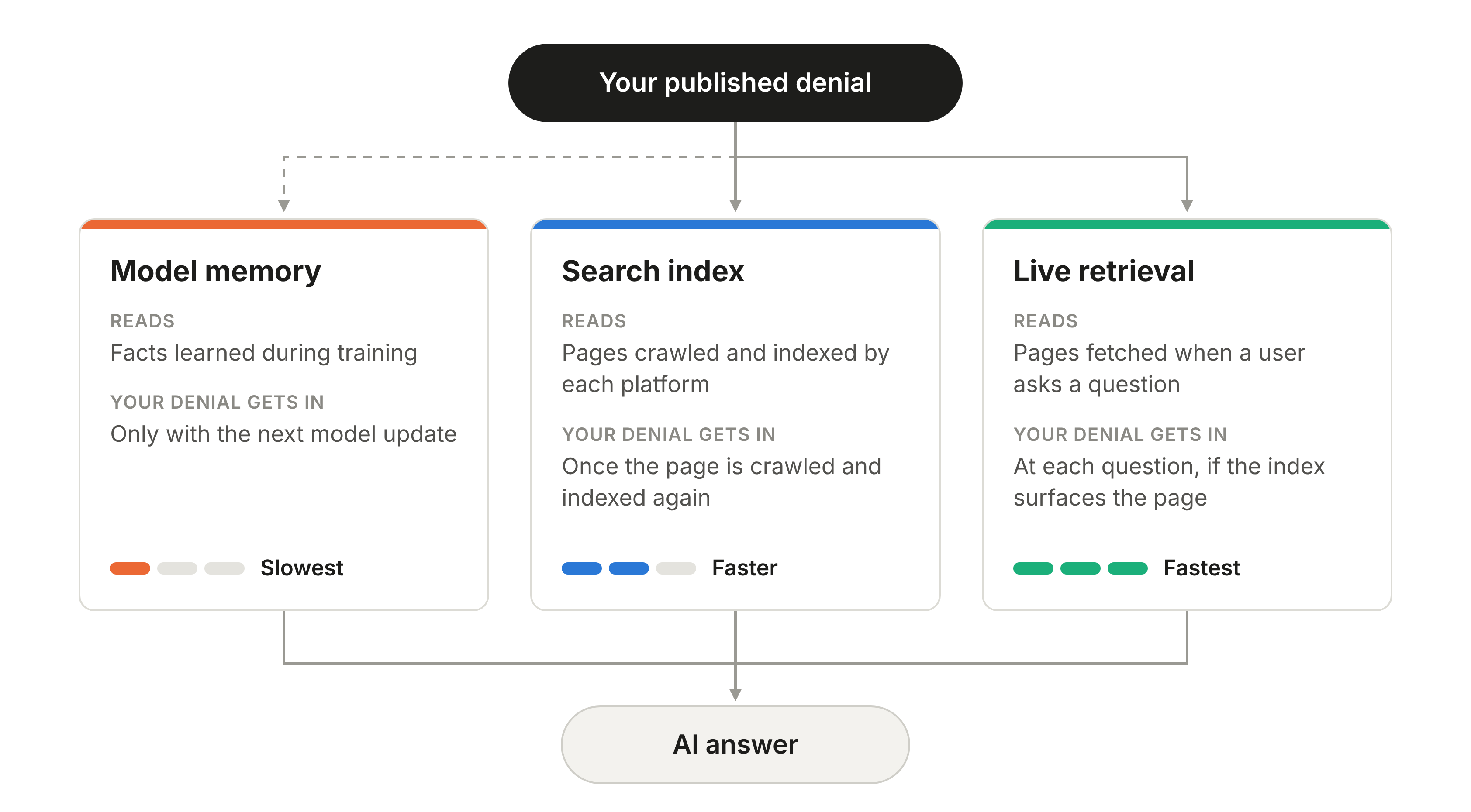
The details matter for a denial. Google states that a page must be indexed and eligible for a snippet to appear as a supporting link in AI Overviews or AI Mode. OpenAI separates GPTBot, which collects training data, from OAI-SearchBot, which surfaces websites in ChatGPT search. Your denial therefore reaches the search layers first, while model memory keeps the version that was online before.
How fast can each layer pick up a correction?
No AI provider publishes a correction delay for company facts. The few public markers point to very different speeds:
- Access: OpenAI says it can take about 24 hours after a robots.txt update for its search systems to adjust.
- Search: a corrected page can only be cited once it has been crawled and indexed again, which depends on each engine's crawl schedule.
- Memory: training data only changes with a new model, and research confirms that models stay weak on recent facts.
The FreshLLMs study, published at ACL 2024 and based on more than 50,000 human judgments, found that all the models tested struggled with fast changing knowledge, whatever their size. A method that adds up to date search results to the prompt outperformed the other approaches tested. In other words, the search layer is where a correction can land first.
Why do third party sources keep the false version alive?
The search layer does not only read your newsroom. In the EBU and BBC study, which analyzed more than 3,000 answers from ChatGPT, Copilot, Gemini and Perplexity with 22 public service media in 18 countries and 14 languages, 31% of answers showed serious sourcing problems: missing, misleading or incorrect attributions.
Third party coverage also weighs more than owned pages. According to Muck Rack's analysis of more than 25 million links, earned media drives 84% of AI citations, journalism alone 27%, and paid content just 0.3%. In practice:
- the article that relayed the fake weighs more than your denial page;
- a sponsored correction will not tip the balance;
- as long as the relay is not corrected, AI has a recent, credible source to repeat the error.
Do AI engines forget a false claim on their own?
Many PR teams assume that AI visibility fades quickly without fresh coverage, so a false claim should fade too. The data partly supports it. Muck Rack found that more than half of the journalism cited by AI was published in the past 12 months, and that citation volume drops sharply after the first six months.
However, forgetting is not correcting. The same mechanism can push your denial out of the answers as fast as the relay article. And a false claim absorbed into model memory does not fade with citations: it stays until the next model update.
The fact checking charity Full Fact offers a more encouraging signal. Since February 2026, it has questioned AI models just before and just after publishing its fact checks. Its August 2026 analysis reports:
- 39 major errors and 67 incorrect responses in the first five months;
- several models corrected themselves once the fact checks were online, often citing them;
- yet 6 errors persisted or appeared after publication.
The lesson: a clear, published correction works more often than waiting, but not every time. The time AI takes to correct itself deserves to be measured case by case.
What changes between a fake press release, an outdated figure and an old crisis?
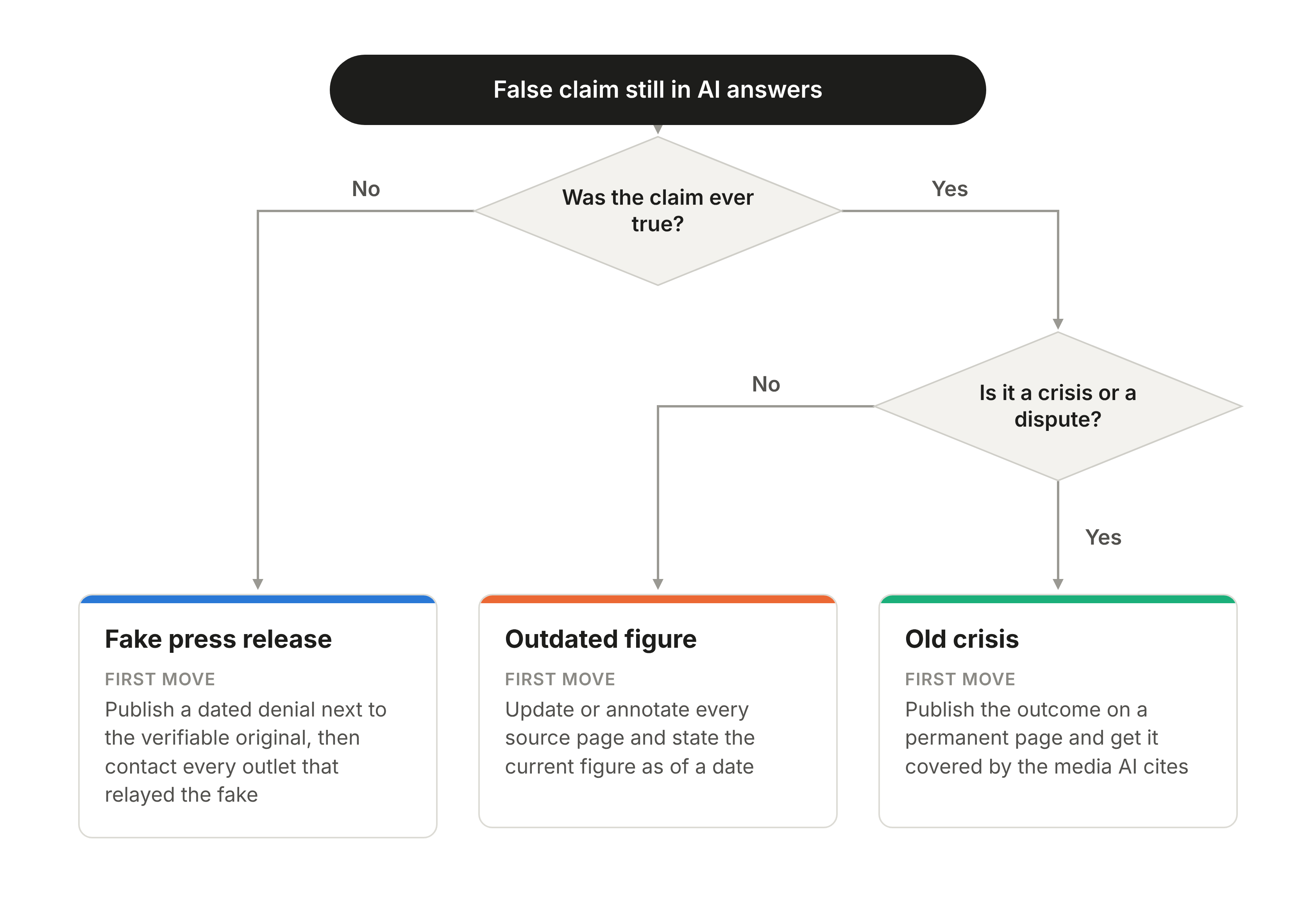
How do you handle a fake press release?
The claim is new and spreads through relays, so speed matters most.
- Publish the denial on your newsroom, next to the original documents.
- List every outlet, aggregator and post that relayed the fake.
- Ask each of them for a correction or an editor's note linking to your denial.
How do you handle an outdated figure?
The source was accurate when published, which makes it credible.
- Update every page you control and state the current figure "as of" a date.
- Annotate old releases rather than deleting them.
- Correct directories, data providers and company profiles.
How do you handle an old crisis that keeps resurfacing?
The articles were true at the time, but AI never read the ending.
- Publish the resolution (ruling, settlement, closed investigation) on a permanent page.
- Get the outcome covered by the outlets AI cites in your sector.
- Avoid a new public statement on the incident itself, which could revive it.
How do you write a denial that AI engines will pick up?
Most denials are written for journalists who already know the story. AI engines, however, compare your text with everything else they find.
Ahrefs, the SEO software company, tested this over two months with 56 questions on 8 AI tools, pitting an official FAQ against three fake sources. ChatGPT cited the FAQ in 84% of answers and repeated the fakes in under 7%. Gemini and Perplexity repeated the planted misinformation in 37 to 39% of answers. The key lesson: between a vague truth and a precise fiction, AI often picks the fiction.
A denial that AI engines can use follows a few rules:
- Name the false claim and the fact in one sentence: "The group is not closing any European plant in 2026."
- Date it and name the speaker, so the answer can say who denied what and when.
- Give verifiable facts: numbers, dates, documents.
- Title it as the question people ask: "Is the group closing plants in Europe?"
- Publish it on a permanent newsroom URL, not only as a PDF or a social post.
- Link the original documents and update your own pages that contradict it.
- Check with your IT team that AI crawlers can access the newsroom.
Why does Digital Provenance strengthen a denial?
A denial has a structural weakness: it is one more document among many, and a fake release can also look official. Digital Provenance answers the question every journalist, investor and engine asks in a crisis: which document really comes from the company?
Solutions such as Wiztrust Protect give every corporate or financial content a proof of origin that anyone can verify publicly and that can be relied on in a disinformation crisis. Your denial and your original release become verifiable; the fake cannot. We detail this effect in our article on content authenticity as reputation insurance.
How do you push the correction to the sources AI engines cite?
Since most persistent errors come from third party pages, the correction has to travel to them. This is where media relations make the difference.
- Start from the citations: run your key prompts and list every URL shown next to the false claim.
- Contact each outlet with the dated denial and the verifiable original, and ask for an update.
- Prioritize the outlets AI cites in your sector, not only those with the largest audience.
- Align third party profiles: directories, data providers, LinkedIn, Wikipedia through its talk page.
- Request indexing on day 0: since Google only cites indexed pages, submit the denial page in Google Search Console and Bing Webmaster Tools.
- Create fresh coverage of the facts, such as an interview, because AI favors recent journalism.
For the full correction method, see our guide on how communications teams can fix their brand's reputation in AI answers.
How long should you track AI answers after a denial?
A correction is only real once the answers change. Since no provider publishes a delay, set a fixed cadence and measure it yourself: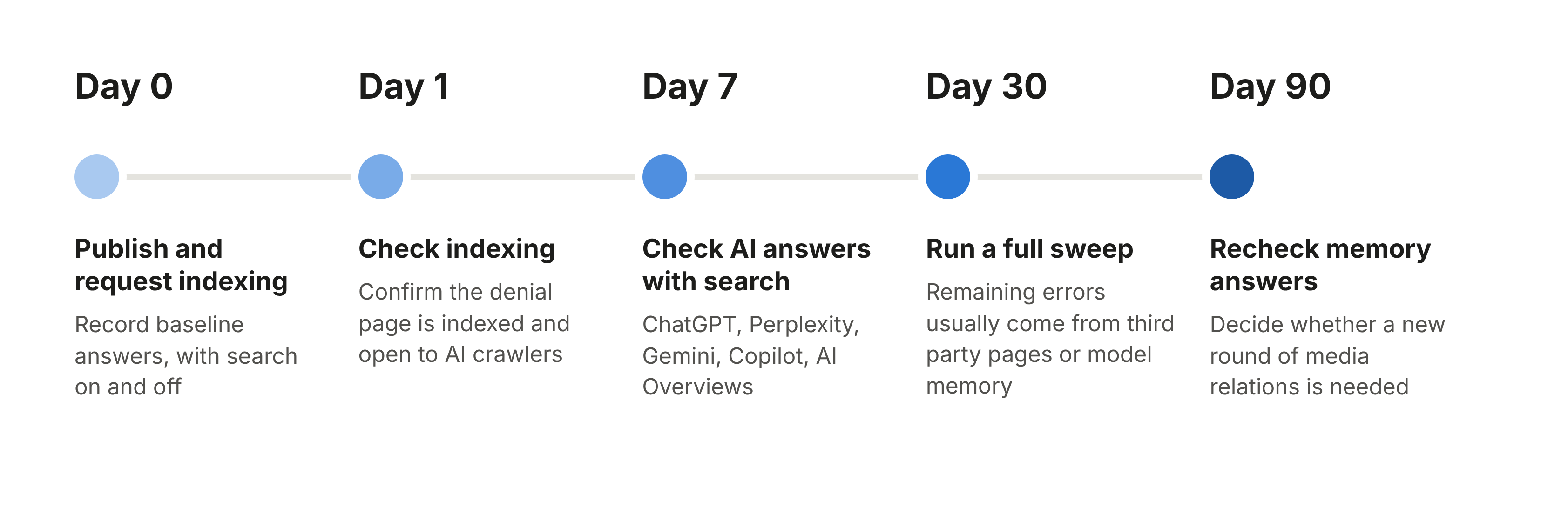 Then track four indicators:
- Persistence rate: share of answers still repeating the false claim.
- Time to correction: days until each engine flips.
- Denial citation rate: share of answers citing your denial or the original.
- Relay citation rate: share of answers still citing the article that carried the fake.
Our guide to the 4 LLM brand visibility KPIs shows how to present them to your executive committee.
What should communications teams remember?
A denial remains essential, but in 2026 it is only the first step. AI engines correct themselves when the sources they read change, and those sources are mostly third party media.
To get AI to stop repeating a false claim:
- spot what the engines repeat and which sources they cite;
- publish a precise, dated and verifiable denial on your official newsroom;
- push it to the media and profiles that AI engines cite;
- track the answers for at least 90 days, until each engine has flipped.
Next step: this week, take your last three denials, run ten prompts on three AI engines and note whether the false version still appears.
FAQ
How long does it take ChatGPT to stop repeating a false claim about a company?
No AI provider publishes this delay. When ChatGPT searches the web, it relies on pages surfaced by OAI-SearchBot, so the answer can change once the corrected page has been crawled again. When it answers from memory, the false claim can persist until the next model update. That is why you should test with search on and off.
Can we ask OpenAI or Google to remove a false claim about our company?
You can flag an answer with the feedback buttons in ChatGPT, Gemini or AI Overviews, but this does not guarantee that a specific fact will be corrected. For defamatory content, involve your legal team. In most cases, correcting the sources the engines read remains the fastest lever.
Should a denial repeat the false claim?
Yes, once and precisely. In the Ahrefs experiment, explicit statements such as "we have never been acquired" helped ChatGPT reject the fakes. Avoid repeating the false wording in titles. Name the claim, state the fact and give the proof.
What tools allow Dircoms to measure their brand's visibility in LLMs?
Two families of tools work together. AI visibility platforms regularly query ChatGPT, Gemini, Perplexity or Copilot with a fixed list of prompts, then measure brand presence, answer accuracy and cited sources. Media monitoring tools show which articles feed those answers. For a communications team, the real value lies in connecting the two, to see which PR actions actually change what AI says. Wiztrust, for example, makes this possible thanks to its partnership with GetMint.
Is there a method to improve brand reputation and visibility in AI answers?
Yes, and it works in three stages. First, measure the gap between how LLMs portray the brand and its objectives. Then, identify the outlets that feed those answers in your sector. Finally, adjust the PR strategy accordingly. This is the approach behind Blueprint GEO, the offer built specifically for communication teams by Wiztrust with GetMint. It is used by companies such as Malakoff Humanis, Business France, Schneider Electric, Macif, Groupama, Gecina and BPCE.
How can we prove that our denial, and not the fake, is the official version?
Publish every release and denial from a single official newsroom and give them a Digital Provenance that anyone can verify. When a fake circulates, point journalists and investors to the verifiable original. The faster you prove what is official, the less time the fake has to settle into the sources AI reads.
 13 min