
 On 3 November, 2026

It is the last week of budget season. Before a board meeting, your CEO asked ChatGPT about the company, then forwarded you the answer with a single line: "Can we fix this?"
By Friday, three proposals sit in your inbox. A reputation agency promises to take control of what AI says about you. An AI visibility startup demos a dashboard full of scores. Your PR platform vendor announces a new GEO module. Prices range from a few hundred to ten thousand dollars a month.
All three claim to deliver AI reputation management, yet they do not solve the same problem. This guide explains what each model really delivers, how to compare vendors, what to budget and which combination fits a corporate communications team.
|
Why read this article 💡 |
Key takeaways
- Three models, three jobs. AI visibility software measures, agencies influence the sources, PR tech platforms produce and prove the official version.
- The need is real but unmet. 45% of marketing leaders cannot accurately measure their AI visibility, and only 9% have tools to track all relevant metrics.
- Rankings are not measurements. The odds of an AI returning the same brand list twice are under 1 in 100.
- Budgets vary widely. Published entry plans for AI visibility platforms range from $19 to $499 a month, while full service agencies charge an estimated $1,500 to $10,000 a month.
- Any guarantee is a red flag. No vendor can promise what an LLM will say about your company.
Three AI reputation management models at a glance
| Model | What it does | Best for | Typical budget | Main limit |
|---|---|---|---|---|
| AI reputation management agency | Audits AI answers, then works on earned media, content and consistent facts | Teams without bandwidth to act, or facing a reputation issue | $1,500 to $10,000 per month (estimate) | Results depend on sources it does not control; methods can be opaque |
| AI visibility software | Runs prompt panels on ChatGPT, Gemini or Perplexity and scores mentions, sentiment and citations | Teams that already run strong PR and need measurement | $19 to $499 per month at entry level, $2,000 to $5,000+ for enterprise | Measures without changing anything; methodologies differ |
| PR tech platform | Publishes, distributes and proves official content, then measures coverage and AI visibility | Listed and regulated companies that need a single source of truth | Annual SaaS contract | Requires adoption by the PR team; AI features vary by vendor |
Table of contents
- Why are communications teams shopping for AI reputation solutions in 2026?
- What are the three families of AI reputation management solutions?
- What can each model really change in AI answers?
- Which criteria should communications teams use to compare vendors?
- How much should you budget for each option?
- Which red flags should end a vendor pitch?
- Which combination fits your organization?
- What should communications teams remember?
- FAQ
Why are communications teams shopping for AI reputation solutions in 2026?
The demand starts with a measurement gap. The Semrush 2026 AI Visibility Index, built on 126 million AI search prompts, found that 45% of marketing leaders cannot accurately measure their brand visibility in AI answers. Only 9% have the tools to track every relevant metric.
PR teams face the same gap. Muck Rack's State of PR 2026, based on 971 usable responses, shows that:
- 73% of PR professionals say GEO is at least somewhat important to their strategy;
- 29% say no one in their organization owns it;
- 39% do not measure GEO at all;
- among those who do, only 25% monitor brand mentions in AI generated answers.
Meanwhile, vendors have rushed in. According to a 2026 market landscape by ThriveStack, pure play AI visibility vendors have raised more than $500 million in disclosed funding. Profound alone reached a $1 billion valuation with a $96 million Series C in February 2026, as reported by Fortune, then raised a $180 million Series D at $1.8 billion in September.
The result is a crowded market where agencies, software vendors and PR platforms all use the same words. Our guide to AI reputation management for communications teams explains why reputation is now decided inside AI answers. This article helps you decide who to work with.
What are the three families of AI reputation management solutions?
Behind the same label, you will find three very different business models. Understanding them first saves weeks of demos.
What do AI reputation management companies deliver?
Agencies sell a service: audit, strategy and execution. The best ones work on what LLMs actually read, namely earned media, expert content and consistent facts across directories and profiles.
- Global networks package dedicated offers. Omnicom Reputation Group launched GEOmni, built on a partnership with 3RD, a GDPR compliant AI visibility platform founded in Copenhagen in 2025.
- Communications agencies build proprietary methods, such as Aura Paris with Aura Score, launched in September 2026, which analyzes six dimensions of how conversational AI describes a brand.
- Online reputation firms, historically focused on search results for executives, now add ChatGPT and Gemini to their scope.
Their strength is execution. Their weakness is dependency: when the contract ends, the method and the history often leave with the agency.
What do AI reputation management tools that analyze LLM responses measure?
These platforms send a fixed panel of prompts to ChatGPT, Gemini, Perplexity, Claude or Copilot, collect the full answers and turn them into indicators:
- mention rate and share of voice against competitors;
- sentiment of each answer;
- sources cited next to your brand;
- evolution over time, by model, market and language.
The supply is abundant, with more than 50 vendors counted in ThriveStack's landscape. Costs can stay modest. Writing in IR Impact, Lydia Prexl, head of corporate communications at the payment provider Unzer, estimates that organizations can expect to spend between €200 and €600 a month depending on the provider, far below a traditional reputation study.
What does a PR tech platform add?
A PR tech platform sits where official content is produced: newsroom, press release distribution, media contacts and coverage measurement. Several now add AI visibility measurement, like Muck Rack with Generative Pulse.
This position matters because of what LLMs read. Muck Rack's analysis of more than 25 million cited links shows that earned media drives 84% of AI citations, against 0.3% for paid content, and that ChatGPT cites sources in 96% of its answers. In other words, the platform that publishes and distributes your content shapes the raw material of AI answers.
What can each model really change in AI answers?
This is the first question to ask every vendor, because measuring is not the same as improving.
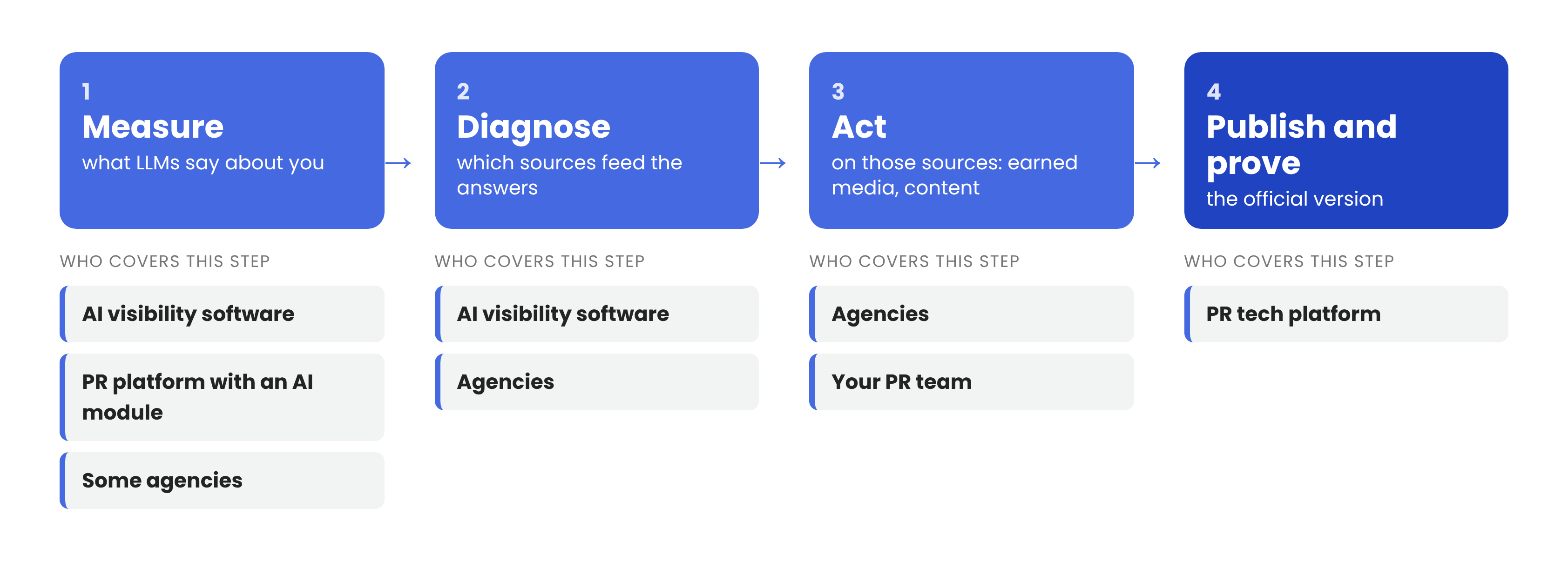
- Software observes. A dashboard does not change a single answer; your team still has to act on the findings.
- Agencies influence, slowly. AI engines offer no paid placement in their organic answers, so no agency can guarantee what they will say.
- Platforms change the upstream. Clear, dated and widely distributed official content gives journalists and engines a credible source to cite.
Practitioners confirm these limits. At Unzer, Lydia Prexl contacted authors and site owners each time she found outdated information, until the effort outweighed the impact. She also notes that many tools generate hundreds of recommendations every month, which can trap teams in a race for GEO content.
Why should you distrust a "position in ChatGPT"?
Because AI answers are probabilistic. SparkToro and Gumshoe ran 2,961 prompts with 600 volunteers, and their January 2026 study is clear: the odds of getting the same brand list twice are under 1 in 100, and closer to 1 in 1,000 for the same list in the same order. Lydia Prexl illustrates the trap with scores: ask a model several times for a reputation score and you may get 72, then 68, then 81, although nothing has changed.
A serious vendor therefore reports how often your brand appears across many runs, with a margin of error. Our article on the 4 LLM brand visibility KPIs details this method.
Which criteria should communications teams use to compare vendors?
Use the same grid for agencies, software and platforms, so that proposals become comparable:
- Methodology: number of runs per prompt, confidence interval, prompts built from your stakeholders' real questions.
- Coverage: models tracked, including European ones such as Mistral's Le Chat, plus your languages and markets.
- Source attribution: the vendor must show which articles and pages feed each answer.
- Action layer: what happens after the diagnosis, and who does the work.
- PR workflow fit: a link between AI visibility, coverage and press releases, so you can tie a result to an action.
- Compliance: GDPR, data hosting, single sign on and security certifications for regulated groups.
- Data ownership: the right to export your history if you change vendor.
Why is proof of origin becoming a selection criterion?
Monitoring tells you what AI says. However, it cannot tell a journalist, an investor or a model which document really comes from your company when a fake press release circulates. That proof sits upstream, in your publishing chain.
This is what Digital Provenance brings. Wiztrust Protect, for example, gives every corporate or financial content a proof of origin that anyone can verify publicly and that can be relied on in a disinformation crisis. Our article on building a corporate trust stack against disinformation shows how provenance and monitoring work together.
How much should you budget for each option?
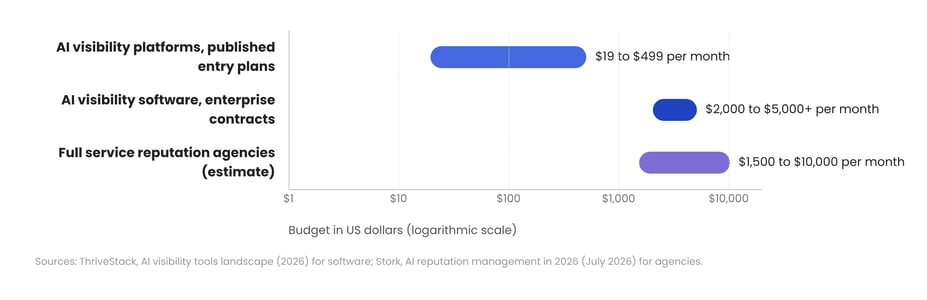
Prices are rarely public, but 2026 market data gives clear orders of magnitude. According to ThriveStack's landscape of more than 50 vendors, published entry plans for AI visibility platforms range from $19 to $499 a month, while enterprise contracts run from $2,000 to $5,000 or more. For full service agencies, the AI tools directory Stork estimates $1,500 to $10,000 a month.
Two remarks before you sign. First, a price per prompt misleads when vendors run each prompt a different number of times. Second, for a large group, the real cost often sits in the team time needed to act on the findings, not in the licence.
Which red flags should end a vendor pitch?
Some promises should stop the conversation immediately:
- a guarantee of results or of a position in ChatGPT;
- an offer to "submit" your brand to an AI engine, since no such form exists;
- a single score with no run count or margin of error;
- a plan built on sponsored content, which weighs only 0.3% of AI citations;
- mass production of AI written FAQs with no editorial line;
- no view of the sources behind the answers;
- no exit clause for your data.
The warning is not theoretical. In June 2026, Google updated its guidance on hiring an SEO: it now lists optimizing for generative AI among typical services and, for the first time, encourages businesses to report deceptive providers to the US Federal Trade Commission.
Which combination fits your organization?
There is no universal answer, but your situation points to a clear starting point.
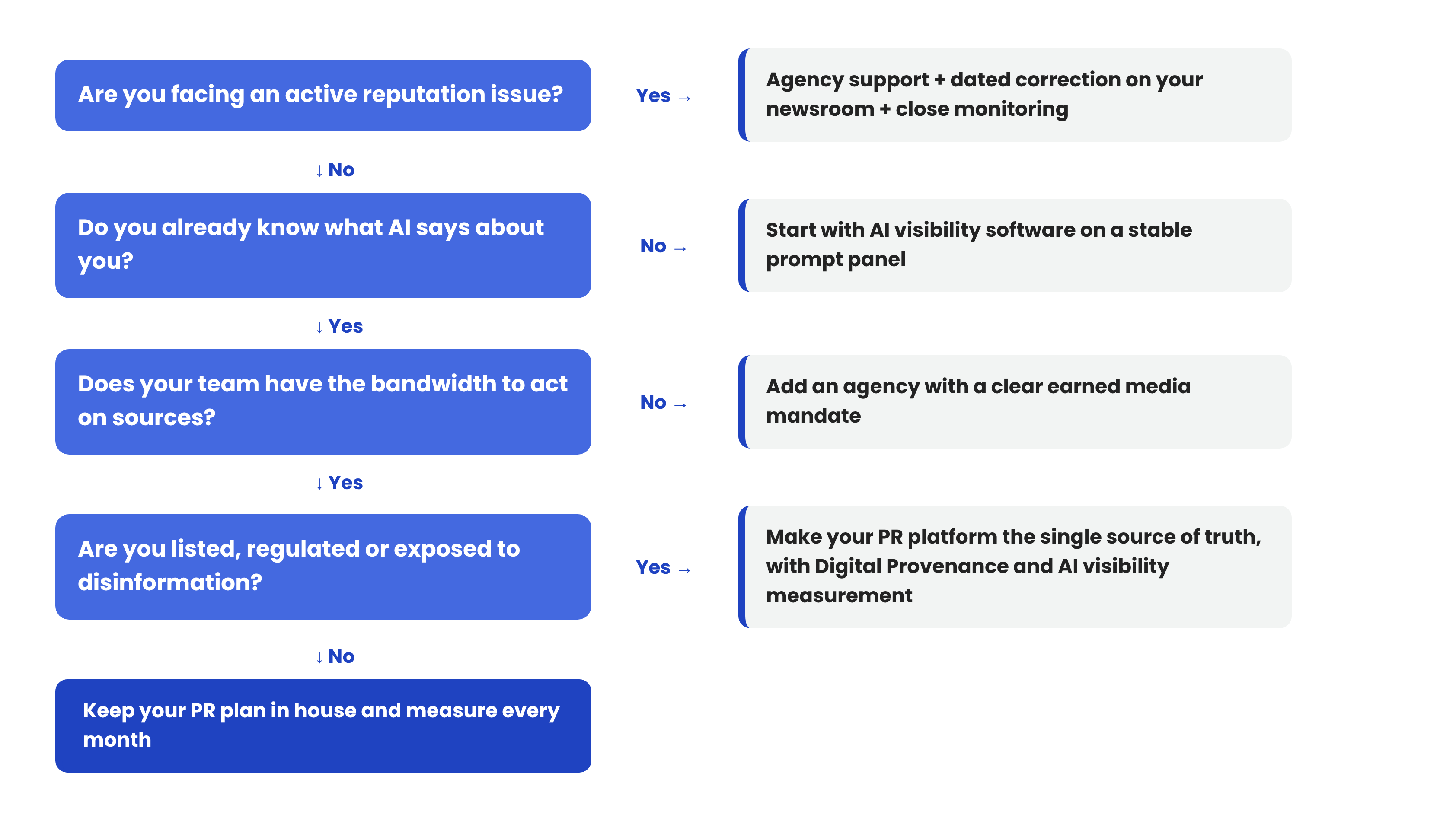
What does a hybrid setup look like in practice?
For most corporate communications teams, the answer is a mix: a platform that publishes and proves, measurement plugged into it, and expertise to turn data into a media plan.
Blueprint GEO, built by Wiztrust with GetMint after one year of collaboration, follows this logic. It measures the gap between how LLMs portray a brand and its objectives, then realigns the PR strategy sector by sector. Eight leading companies adopted it at launch. In the company's 2026 study of the 40 CAC 40 newsrooms, the newsrooms it powers scored 77.3 out of 100 in visibility, against 58.8 for other solutions, and 80% of them were cited as a source by AI engines.
What should communications teams remember?
AI reputation management is not one purchase but three jobs: measuring, influencing and proving. With Gartner expecting PR and earned media budgets to double by 2027, according to its Predicts 2026 research, the choice deserves the same rigor as any media investment.
To choose well:
- pick software to see, an agency to act and a platform to publish and prove;
- compare vendors on methodology, sources and data ownership, not on scores;
- budget for team time, not only for licences;
- reject any guarantee.
Next step: list the ten questions your stakeholders ask AI about your company, run them on three engines, then bring the grid above to your next vendor meeting.
FAQ
What is the difference between an AI reputation management company and an AI reputation management tool?
A company, usually an agency, sells a service: it audits AI answers, then works on the sources LLMs read through media relations and content. A tool is software that queries LLMs with a panel of prompts and measures mentions, sentiment and citations. The tool tells you where you stand; the agency helps you move. Many corporate teams combine both, with their PR platform as the source of official content.
What tools allow Dircoms to measure their brand's visibility in LLMs?
Two families work together. AI visibility platforms regularly query ChatGPT, Gemini, Perplexity or Copilot with a fixed list of prompts, then measure brand presence, answer accuracy and cited sources. Media monitoring tools show which articles feed those answers. The real value lies in connecting the two, to see which PR actions change what AI says. Wiztrust, for example, makes this possible thanks to its partnership with GetMint.
Can an agency guarantee what ChatGPT says about our company?
No. LLM answers are probabilistic and change from one run to the next, and no vendor has a paid placement or a submission form with OpenAI, Google or Anthropic. A serious agency commits to actions and to a measurement method, not to an output.
Is there a method to improve brand reputation and visibility in AI answers?
Yes, and it works in three stages. First, measure the gap between how LLMs portray the brand and its objectives. Then, identify the outlets that feed those answers in your sector. Finally, adjust the PR strategy accordingly. This is the approach behind Blueprint GEO, the offer built specifically for communication teams by Wiztrust with GetMint. It is used by companies such as Malakoff Humanis, Business France, Schneider Electric, Macif, Groupama, Gecina and BPCE.
Which media should we target to influence AI answers in our sector?
It depends heavily on the sector, which is why a generic media list is not enough. The Wiztrust and GetMint barometer shows, for example, that in banking a single outlet captured 52.7% of AI citations. Start from the outlets that LLMs actually cite on your topics, then build your media plan around them.
How long does it take to see results in AI answers?
Expect weeks to months rather than days, because you are changing the sources that AI engines read and waiting for them to pick up new material. Set a baseline in the first month, measure monthly, and review the strategy every quarter with your executive committee.
 13 min