
 On 16 October, 2026

It is 8:30 on a Monday. Your CEO forwards a ChatGPT answer that still describes last year's restructuring as ongoing. Meanwhile, a journalist asks about an NGO report on your climate claims, an analyst questions your guidance, and a former employee's post is gaining traction on LinkedIn.
Four fronts, one morning, and each one feeds the others. That is what corporate reputation management looks like in 2026.
This guide gives Dircoms and Heads of PR a complete framework: the six arenas where corporate reputation is now built, who should own each one, and how to steer them all, AI answers included.
|
Why read this article 💡 |
Key takeaways
- Reputation is a balance sheet issue. Intangible assets now represent about 92% of S&P 500 market value, according to Ocean Tomo.
- Most companies plan, few quantify. 53% of organizations have a response plan for reputation risk, but only 12% have quantified it (Aon).
- Trust has moved closer to home. In the 2026 Edelman Trust Barometer, employers are trusted by 78% of their employees.
- AI answers are now a reputation arena. 10% of people use AI chatbots for news every week, and that share keeps rising.
- Media relations now also feed AI. 84% of AI citations come from earned media, which makes your press office the first lever of your AI reputation.
The six arenas of corporate reputation at a glance
| Arena | Who shapes your reputation there | Main risk in 2026 | Lead owner | Core KPI |
|---|---|---|---|---|
| Media | Journalists, trade outlets, editorial writers | Inaccurate or hostile coverage | Head of PR | Share of voice and tone of coverage |
| Financial markets | Investors, analysts, rating agencies | Inconsistent or leaked market sensitive information | Head of IR with the Dircom | Consistency of messages across publications |
| Employees | Staff, candidates, managers | Internal distrust that spills over online | Internal communications with HR | Employee trust and advocacy |
| ESG and regulators | NGOs, supervisors, ESG raters | Greenwashing accusations and sanctions | CSR director with legal | Controversies and ESG ratings |
| Social networks | Communities, influencers, activists | Viral misinformation and fake content | Social media lead | Velocity and sentiment of mentions |
| AI answers | ChatGPT, Gemini, Perplexity, Copilot, Google AI Overviews | Outdated or false answers repeated at scale | Dircom with the newsroom team | AI visibility, accuracy and citation rate |
Table of contents
- What is corporate reputation management in 2026?
- Which six arenas shape corporate reputation today?
- How can communications teams build a reputation management system in five steps?
- Which mistakes weaken corporate reputation management?
- What should communications teams do in the next 90 days?
- FAQ
What is corporate reputation management in 2026?
Corporate reputation management, also called company reputation management, is the set of practices a company uses to understand, shape and protect the way its stakeholders perceive it. Unlike online reputation management, which focuses on reviews and consumer sentiment, it covers every audience that matters to a large group: journalists, investors, employees, regulators, the public and now AI engines.
In practice, it brings together:
- listening: monitoring what is said about the company, where, and by whom;
- shaping: publishing a consistent narrative through media relations, owned channels and spokespeople;
- protecting: anticipating risks, preparing for crises and proving what is official;
- measuring: turning perceptions into KPIs the executive committee can act on.
Why is reputation now a balance sheet matter?
Reputation is no longer a soft topic. According to Ocean Tomo, tangible assets represented 83% of S&P 500 market value in 1975. Today, intangible assets, which include brand and reputation, make up about 92% of it.
Risk managers see it too. The Aon Global Risk Management Survey shows that:
- damage to reputation or brand ranks eighth among global business risks in 2025;
- respondents expect it to fall to nineteenth by 2028, which suggests a risk of complacency;
- only 9% of respondents reported losses from it, which makes the risk easy to underestimate;
- 53% have a response plan, but only 12% have quantified the risk.
That last gap is where communications teams can make a difference: they hold the data that turns reputation into a measurable asset.
What has changed for company reputation since 2024?
Three shifts have redrawn the map for Dircoms.
- Trust has become insular. The 2026 Edelman Trust Barometer, based on nearly 34,000 respondents in 28 countries, finds that seven in 10 people are unwilling or hesitant to trust someone with different values.
- Misinformation weighs on trust. 50% of respondents cite the increasing prevalence of misinformation as an event that affected their trust over the past five years.
- AI has become an intermediary. Stakeholders increasingly ask an AI assistant before they read your website, your release or an article about you.
As a result, reputation is no longer built in one place. It is assembled from many sources, then summarized by machines.
Which six arenas shape corporate reputation today?
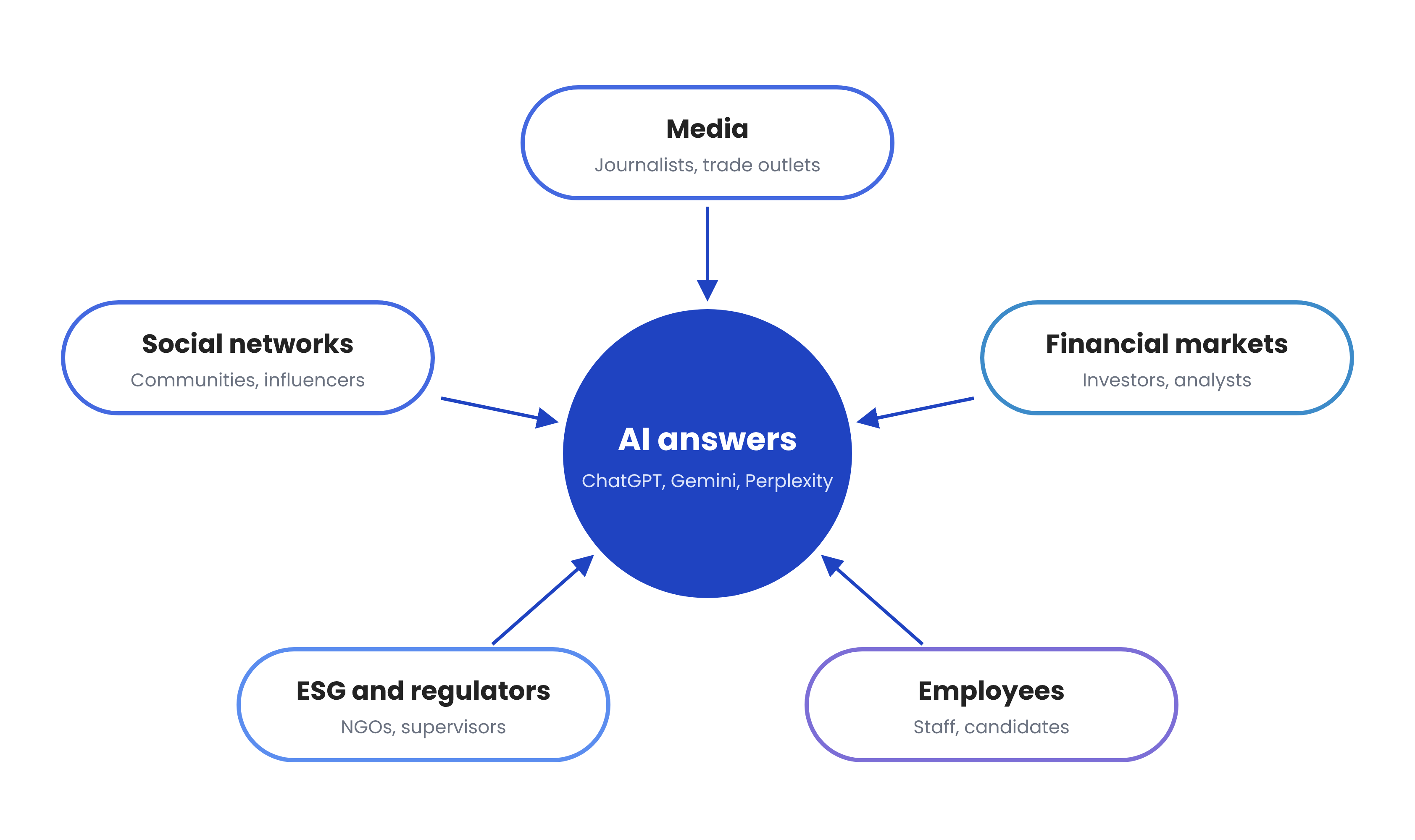
Each arena has its own audience, its own risks and its own rhythm. However, they are deeply connected: a weak signal in one arena often becomes a crisis in another.
How do the media still set the agenda?
The media remain the backbone of corporate reputation. They set the agenda, give context to your announcements and, more than ever, feed the other arenas.
Indeed, Muck Rack's analysis of more than 25 million links cited by ChatGPT, Claude and Gemini shows that:
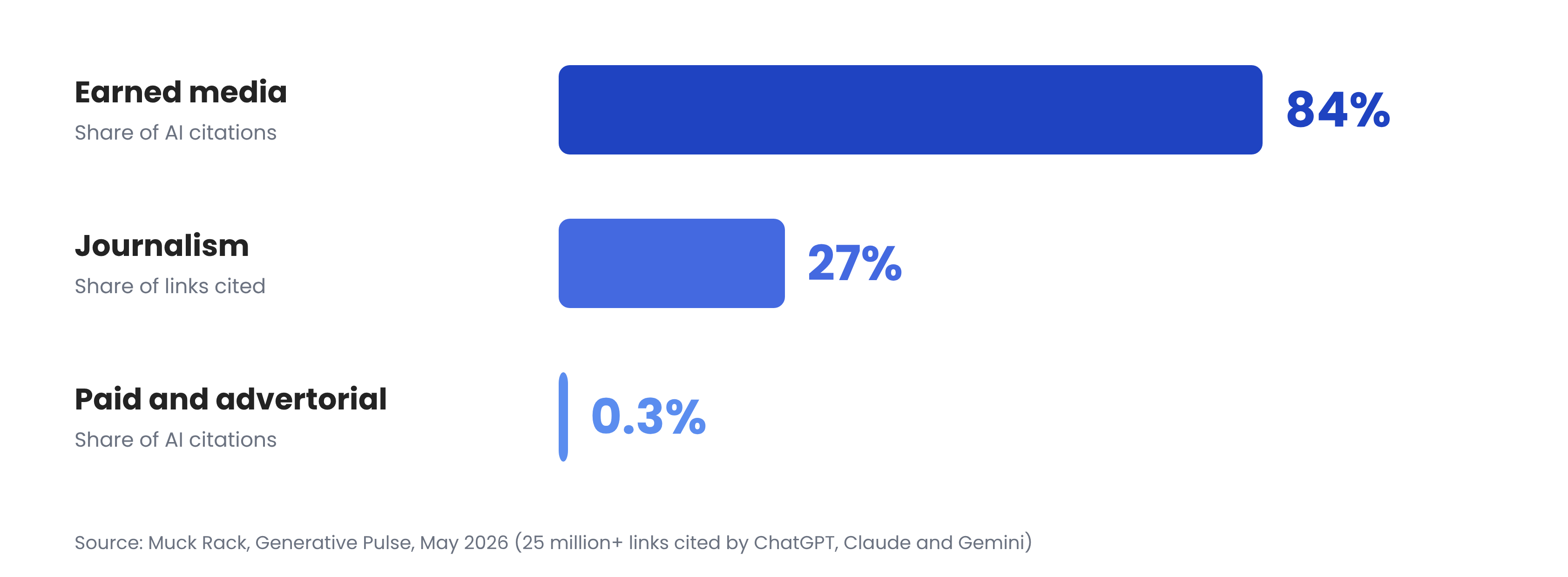
In other words, every article about your company is read twice: by people today, and by AI engines tomorrow. Therefore, media relations should prioritize the outlets that matter in your sector, not only those with the largest audience.
What do financial markets expect from communications?
For listed companies, reputation and valuation are closely linked. Investors and analysts expect accurate, timely and consistent information.
The main levers here are:
- one narrative: strategy, results and ESG commitments must tell the same story in the annual report, the press release and the investor presentation;
- secure distribution: market sensitive information must reach everyone at the same time, through controlled channels;
- close coordination between PR and IR: a quote given to a journalist is also read by analysts.
When these rules are not respected, a reputational issue quickly becomes a regulatory one.
Why are employees your most credible spokespeople?
In an insular world, people trust those closest to them. According to Edelman, "my employer" is the most trusted institution, with 78% trust among employees, and "my CEO" is trusted by 66% of respondents.
This creates both an opportunity and a risk:
- the opportunity: employees who understand the strategy become credible ambassadors with candidates, clients and their own networks;
- the risk: internal distrust spreads fast on LinkedIn, Glassdoor or Reddit, then reaches journalists.
Consequently, internal communications is not a separate topic. It is one of the six pillars of your corporate reputation.
How do ESG and regulators raise the stakes?
ESG has turned reputation into a matter of proof. Climate targets, diversity data and governance commitments are now scrutinized by NGOs, ESG raters, supervisors and journalists.
For Dircoms, this means:
- aligning claims with evidence: every environmental or social claim needs a documented source;
- working with legal and CSR teams before publishing ambitious commitments;
- monitoring controversies, because one NGO report can shape your coverage for years.
Greenwashing accusations are particularly damaging for banks, insurers and industrial groups, since they combine reputational, legal and financial risk.
Why do social networks accelerate every reputation risk?
Social networks are where weak signals become storms. They amplify criticism, rumors and, increasingly, fake content.
Concern is high: 65% of respondents worry that foreign actors are injecting falsehoods into national media to inflame domestic divisions. Companies are not immune: a fake press release, a doctored document or a deepfake video of an executive can circulate within minutes.
The right posture combines:
- real time monitoring of mentions and their velocity;
- clear escalation rules between the social media team and the Dircom;
- fast access to official, verifiable content to answer with facts.
Why have AI answers become the sixth arena?
AI answers are the newest arena, and the one that summarizes all the others. When a journalist, an investor or a candidate asks ChatGPT about your company, the answer blends media coverage, your own pages, social content and databases.
The audience is already significant. The Reuters Institute Digital News Report 2026 shows that:
- 10% of people use AI chatbots for news every week, up from 7% a year earlier;
- 16% of under 35s already do so;
- trust in AI chatbot answers is 20%, compared with 37% for news overall;
- 42% of AI chatbot users for news always or often click through to the original sources.
Sources also vary by sector. The monthly barometer by Wiztrust and GetMint shows that in IT services, the leading outlet captures only 7.1% of AI citations, against 52.7% for a single outlet in banking. In insurance, 28% of the citations analyzed come from insurers' own websites.
This is why your owned content matters as much as your coverage. We detail the specific playbook in our guide on how to master AI reputation management in 2026, and in our method to fix your brand's reputation in AI answers.
How can communications teams build a reputation management system in five steps?
A framework only works if it becomes a routine. Here is a five step system that a corporate communications department can roll out in one quarter.
Step 1: how do you map your stakeholders and arenas?
Start by drawing the map of what drives your reputation.
- List your priority stakeholders in each of the six arenas.
- For each one, identify the questions they ask about you and where they look for answers: outlets, platforms, AI assistants.
- Rank the arenas by business impact. A listed bank will not have the same priorities as an industrial group preparing an acquisition.
The result is a one page reputation map, shared with the executive committee.
Step 2: who should own each arena?
Reputation is everyone's business, which often means it is nobody's. Therefore, give each arena a clear owner and a clear coordinator.
- The Dircom owns the overall narrative and arbitrates between arenas.
- Each arena has a lead: PR, IR, internal communications, CSR, social media and the newsroom team.
- A monthly reputation committee brings them together, with legal and risk management when needed.
This governance avoids the classic situation where IR, HR and PR answer the same question three different ways.
Step 3: how do you turn your newsroom into the single source of truth?
Every arena needs a reliable reference. Your newsroom should be that place, for journalists, investors, employees and AI engines alike.
- Publish complete, dated content: results, governance, key figures, executive bios and positions on recurring topics.
- Structure it for machines too: question based headings, FAQs and structured data help AI engines extract facts accurately.
- Keep it current: an outdated page keeps feeding outdated answers, in the press and in AI.
This is also where infrastructure makes a measurable difference. In the CAC 40, newsrooms run on Wiztrust reach an 80% GEO citation rate, compared with a 57% average.
Step 4: how do you prepare for a reputation crisis?
Aon's data is a warning: a plan without quantification is a plan without priorities. Your crisis preparation should therefore cover:
- scenarios for each arena: a hostile investigation, a data leak, a greenwashing accusation, a fake release, a viral employee post, a false AI answer;
- a decision tree: who detects, who validates, who speaks, through which channel and within which deadline;
- holding statements validated in advance by the communications team with legal;
- proof of authenticity: Digital Provenance lets anyone verify that a release really comes from your company and has not been altered, which helps journalists and investors dismiss a fake before it spreads.
Test the plan at least once a year with a simulation involving the executive committee.
Step 5: how do you measure and report corporate reputation?
Finally, reputation must be reported like any other strategic asset. Combine indicators from each arena in one monthly dashboard:
- media: share of voice, tone and presence in priority outlets;
- financial markets: consistency of messages and analyst feedback;
- employees: trust and advocacy indicators from internal surveys;
- ESG: number and severity of controversies, ESG ratings;
- social networks: volume, velocity and sentiment of mentions;
- AI answers: visibility, accuracy and share of citations pointing to your official sources.
For the last arena, our article on the four LLM brand visibility KPIs to track in 2026 details the method.
Which mistakes weaken corporate reputation management?
Even mature teams fall into a few traps:
- Managing arenas in silos: a consistent story in the press is undermined by a contradictory answer from IR or HR.
- Monitoring without acting: dashboards are useless if nobody owns the response.
- Ignoring AI answers: they now summarize your reputation for a growing share of stakeholders.
- Relying on paid content: sponsored content accounts for only 0.3% of AI citations, so it will not fix a reputation issue.
- Leaving outdated content online: old releases and bios keep feeding journalists and AI engines.
- Preparing a crisis plan once: scenarios age as fast as your organization and your risks.
What should communications teams do in the next 90 days?
Corporate reputation in 2026 is built across six connected arenas, and AI engines now summarize them all. The good news is that communications teams already hold the main levers: media relations, owned content and governance.
To sum up, a solid corporate reputation management strategy means:
- mapping the six arenas and your priority stakeholders;
- giving each arena an owner and a KPI;
- turning your newsroom into the single source of truth;
- preparing crisis scenarios that include fake content and false AI answers;
- reporting reputation monthly to the executive committee.
Your next step is simple: this month, run your reputation map, then test ten critical questions about your company on three AI assistants. You will see in one hour where your next priorities lie.
FAQ
What is the difference between corporate reputation management and online reputation management?
Online reputation management focuses mainly on reviews, social media and search results, often for consumer brands. Corporate reputation management covers every stakeholder of a large organization: media, investors, employees, regulators, the public and AI engines. It is led by the communications department and reported to the executive committee.
Who should own corporate reputation in a large company?
The Dircom should own the overall narrative and coordinate the arenas. However, ownership is shared: IR leads the financial arena, HR and internal communications the employee arena, CSR and legal the ESG arena. A monthly reputation committee keeps these teams aligned.
How often should we measure company reputation?
Track operational indicators such as media coverage, social mentions and AI answers monthly. Review deeper indicators such as employee trust, ESG ratings and stakeholder perception studies quarterly or yearly. After each major announcement or crisis, run a dedicated check.
What tools allow Dircoms to measure their brand's visibility in LLMs?
Wiztrust is a communications platform built for Dircoms. Thanks to its partnership with GetMint, it allows communications teams to measure their brand's visibility on AI platforms, identify the sources cited in their sector and track the impact of their PR actions over time.
Is there a method to improve brand reputation and visibility in AI answers?
Yes. Blueprint GEO is the offer built specifically for communication teams by Wiztrust with GetMint. It measures the gap between how LLMs portray a brand and its objectives, then adjusts the PR strategy by sector. As announced in its launch release, it is used by companies such as Malakoff Humanis, Business France, Schneider Electric, Macif, Groupama, Gecina and BPCE.
How can we protect our reputation against fake press releases and deepfakes?
Publish every release from a single official newsroom and give it a verifiable Digital Provenance, so that anyone can check its origin and integrity. This is what Wiztrust Protect, a Digital Provenance solution, makes possible: every corporate or financial release carries a publicly verifiable proof of origin that you can rely on during a disinformation crisis. Combine this with real time monitoring and a crisis protocol that covers fake content. The faster you can prove what is official, the less a fake can spread.
 15 min