

 On 2 October, 2026

A synthetic video of your CEO, an AI voice over for your results webcast, a "photo" of a plant that was never shot. Until this summer, publishing any of these without a word of explanation was a reputational choice. Since 2 August 2026, in the European Union, it has become a legal question.
The EU AI Act Article 50 sets the AI Act transparency obligations for chatbots, synthetic content and deepfakes. However, much of what circulates online mixes up two very different deadlines. This guide explains each Article 50 transparency obligation, separates what communications teams must already do from what arrives on 2 December 2026, and gives you a checklist to comply.
| Value Box 💡 The value you will find in this content is a clear view of the EU AI Act Article 50 transparency obligations: since 2 August 2026, communications teams must label deepfakes and unreviewed AI generated text on public interest topics, while 2 December 2026 is the date by which older generative AI tools must watermark their outputs. A five-step compliance checklist is included. |
Key Takeaways
- Your AI Act transparency obligations already apply. Deployer duties under EU AI Act Article 50 have been in force since 2 August 2026.
- 2 December 2026 concerns AI providers. Generative tools placed on the market before 2 August must add machine readable marks to their outputs by that date.
- Deepfakes must always be disclosed. This covers realistic images, audio or video of real people, places or events.
- AI text is exempt if a human is accountable. Human review and a responsible editorial entity remove the labelling duty for public interest text.
- Fines are real. Breaches can cost up to 15 million euros or 3% of worldwide turnover.
- Provenance becomes your proof. Certifying authentic content protects you when AI content becomes easier to detect.
EU AI Act article 50 transparency obligations at a glance
| Obligation | Who is responsible | Applies since | What it means for your team |
|---|---|---|---|
| Label deepfakes (image, audio, video) | Deployer: your company | 2 August 2026 | Visible disclosure on any realistic synthetic content of real people, places or events |
| Label AI text on public interest matters | Deployer: your company | 2 August 2026 | Disclose, unless a human reviewed it and your organisation takes editorial responsibility |
| Tell people they are talking to an AI | Provider of the chatbot | 2 August 2026 | Check that any chatbot on your newsroom or website says it is an AI |
| Mark AI outputs in a machine readable way | Provider of the AI tool | 2 August 2026 for new tools, 2 December 2026 for tools already on the market | Your AI content will carry detectable watermarks and metadata |
Table of Contents
- What are the AI Act transparency obligations in Article 50?
- Which Article 50 transparency obligations apply to communications teams since 2 August 2026?
- Why does 2 December 2026 matter in the EU AI Act Article 50 timeline?
- What are the risks of breaching AI Act transparency obligations?
- How to comply with EU AI Act Article 50 before 2 December
- How Wiztrust helps communications teams stay transparent
- FAQ
- Conclusion
What are the AI Act transparency obligations in article 50?
Article 50 makes up Chapter IV of the AI Act, titled "Transparency obligations for providers and deployers of certain AI systems". It targets AI systems that could mislead people about what is real, and it splits duties between two actors.
- Providers build or sell the AI system, such as an image generator or a large language model.
- Deployers use that system in a professional context, which is exactly what a communications department does.
According to the European Commission's Q&A on Article 50, providers must mark generative outputs "in a machine readable format and detectable" as artificially generated. Deployers, for their part, must clearly label deepfakes and AI generated text published on matters of public interest.
The Article 50 transparency obligations, paragraph by paragraph
| Paragraph | Transparency obligation | Who must comply |
|---|---|---|
| 50(1) | Inform people that they are interacting with an AI system | Provider |
| 50(2) | Mark synthetic audio, image, video and text as AI generated, in a machine readable and detectable way | Provider |
| 50(3) | Inform people exposed to emotion recognition or biometric categorisation | Deployer |
| 50(4) | Disclose deepfakes and AI text published on matters of public interest | Deployer |
| 50(5) | Give this information clearly, at the latest at first interaction or exposure, in an accessible way | Provider and deployer |
| 50(7) | Support these obligations with codes of practice | AI Office |
For a Dircom, paragraphs 1 and 4 matter most. Paragraph 2 matters indirectly, because it changes how visible your AI use becomes.
When and how the disclosure must appear
The rules are precise about form. Disclosure must be given "at the latest at the time of the first interaction or exposure", as the AI Act analysis of Article 50 summarises. It must also be "clear and distinguishable" and meet accessibility requirements.
In practice, this means:
- a label visible from the first second of a video, not only in the credits;
- an audio disclaimer for an AI voice, not only a line in the description;
- a caption on an image, not a tag hidden in the file name.
Which Article 50 transparency obligations apply to communications teams since 2 August 2026?
Your team is a deployer each time it uses a generative tool to produce content it publishes. Therefore, two categories of content now require attention.
Deepfakes: every realistic synthetic image, audio or video
The Commission describes a deepfake as content resembling existing people, objects, places or events that "would falsely appear to a person to be authentic or truthful". In a communications department, typical cases include:
- an avatar video of an executive reading the annual message;
- a cloned voice of a spokesperson for a podcast or a webcast;
- a realistic image of a real site, product or event generated from a prompt;
- a photo of a real event heavily altered by AI, for instance by adding people.
On the other hand, a clearly stylised illustration that nobody would take for a photograph is not a deepfake. It will still carry the provider's machine readable mark, however.
There is one nuance for creative work. If the content is "evidently artistic, creative, satirical, fictional", disclosure can be lighter and must not spoil the work. A brand campaign film may fall here, whereas an institutional video of your CEO will not.
AI text on matters of public interest
The second category covers AI generated or manipulated text "published with the purpose of informing the public on matters of public interest". Corporate statements on a crisis, a public health issue or a financial event can clearly enter this scope.
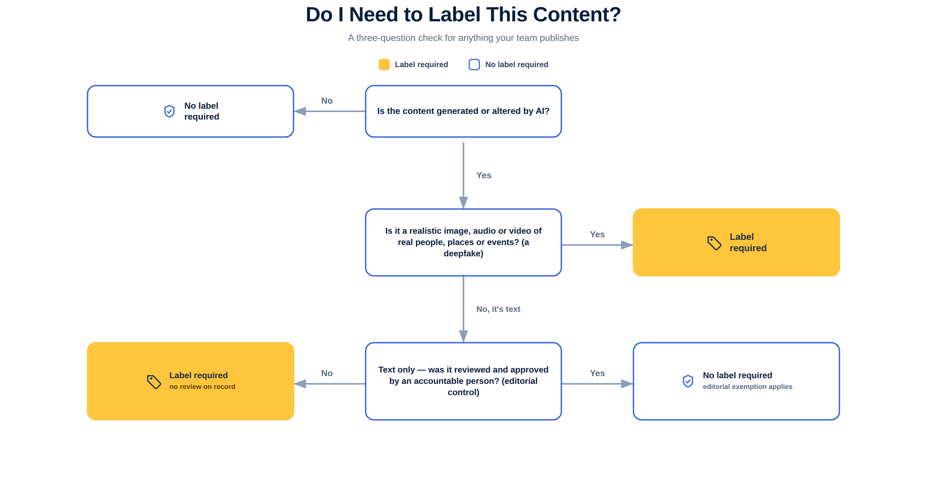
Fortunately, the text contains a major exemption. The labelling duty does not apply when the content went through "human review or editorial control" and a person or organisation holds editorial responsibility. The Commission Q&A specifies two conditions:
- a deliberate examination of the content by one or more people with relevant expertise;
- effective control by a responsible editorial entity with the authority to approve or reject it.
In other words, a press release drafted with AI, then reviewed, amended and signed off by your communications director, generally falls under the exemption. A text published automatically by an AI agent, without anyone reading it, does not.
Chatbots on your newsroom or website
If you offer a conversational assistant to journalists or investors, it must state that it is an AI. That duty sits with the provider. Nevertheless, if your team configured the chatbot or had it built, check that the notice appears at the start of the conversation.
Why Does 2 December 2026 Matter in the EU AI Act Article 50 Timeline?
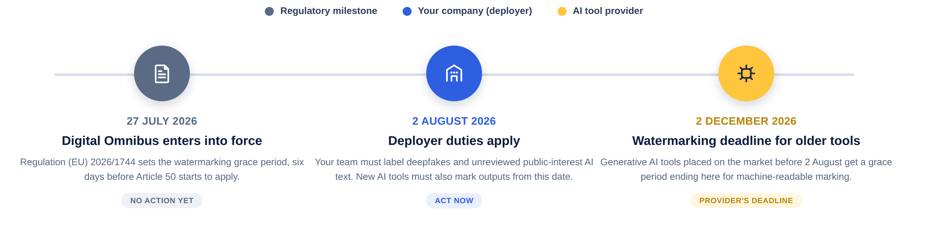
This is where most confusion comes from. The date was introduced by the Digital Omnibus on AI, which entered into force on 27 July 2026 as Regulation (EU) 2026/1744, six days before Article 50 started to apply.
As White & Case explains, generative systems "placed on the market before 2 August 2026 benefit from a short grace period: compliance with the watermarking obligation is required by 2 December 2026". Systems launched after 2 August must comply immediately.
What changes concretely for your team
- The deadline is not yours. It concerns the companies that publish the AI tools you use.
- Your AI content becomes detectable. From December, images, videos, audio and text from these tools should carry watermarks and metadata that platforms and journalists can read.
- Undisclosed deepfakes become easier to expose. If your synthetic video carries a mark but no visible label, the gap will be obvious.
- Your authentic content needs proof too. When everything AI is tagged, the question for real content becomes: "Can you prove it comes from you?"
What the code of practice adds
On 10 June 2026, the Commission published its Code of Practice on marking and labelling AI generated content. It is voluntary, yet it describes what good compliance looks like.
- For providers: a layered approach combining metadata, watermarks and fingerprinting, because "any single marker can be stripped", as ActReady's review of the final Code notes.
- For deployers: internal processes to demonstrate compliance, plus common EU icons. According to Addleshaw Goddard, there are three: a basic AI icon, an "AI generated" icon and a "partially AI modified" icon.
The Commission also published guidelines on transparency obligations on 20 July 2026, which help qualify borderline cases.
What are the risks of breaching AI Act transparency obligations?
The legal risk is significant. Breaches of Article 50 can lead to fines of up to 15 million euros or 3% of total worldwide turnover, according to the Commission Q&A.
However, the reputational risk arrives faster. Consider three signals:
- AI is everywhere in PR. Muck Rack's 2026 report found that 76% of PR professionals use generative AI, yet only 51% work in an organisation with a formal AI policy.
- The public is wary. The Reuters Institute Digital News Report 2026 shows that 62% of respondents are concerned about fake news online, up 4 points.
- Deepfakes already cost millions. In 2024, an Arup employee transferred about 25 million dollars after a video call with a deepfake of the CFO, as reported by Fortune.
For listed companies, the stakes are higher still. A fake statement attributed to your company can move a share price, as we explained in our article on market manipulation through fake press releases.
How to comply with EU AI Act Article 50 before 2 December
The good news: compliance mostly relies on habits your team already has. Here is a five step plan.
1. Map your AI uses
- List every generative tool used by the team, agencies and freelancers.
- For each one, note the content produced: text, image, audio or video.
- Identify which outputs are published externally.
2. Classify your content
3. Document your editorial control
- Keep a trace of who reviewed and approved each piece of content.
- Formalise your validation workflow in your AI policy.
- Our guide on AI governance for press releases details a five step control framework.
4. Standardise your labels
- Adopt the EU icons from the Code of Practice for visual content.
- Write one standard disclaimer per format: video, audio, image and text.
- Brief your agencies so that they apply the same rules.
5. Prove the authenticity of what you publish
Labelling AI content is only half of the job. The other half is proving that your official content is genuine and has not been altered.
This is the role of Digital Provenance, which we explain in what digital provenance means for PR teams. Gartner even listed it among the top trends of the year, as covered in what communications teams should do now. For the fuller picture on how these ideas connect, read our article on provenance, authenticity and integrity for corporate content.
How Wiztrust helps communications teams stay transparent
Wiztrust works with communications and investor relations departments of large European groups. Three features answer the Article 50 challenge directly.
- Wiztrust Protect applies Digital Provenance to your press releases and documents. Recipients can check that a release really comes from you, as shown in how to verify a press release with Wiztrust Protect.
- Wiztrust platform keeps a trace of who drafted, reviewed and approved each release, which supports your editorial control exemption.
- The newsroom gives journalists and AI engines a single official source. You can see how we publish on the Wiztrust newsroom, and how CAC 40 companies perform in our CAC 40 newsroom study.
FAQ
What are the AI Act transparency obligations?
They are the rules set by EU AI Act Article 50. Providers must disclose AI interactions and mark synthetic content, while deployers must disclose deepfakes, AI text on public interest matters, and the use of emotion recognition or biometric categorisation. They have applied since 2 August 2026.
Does EU AI Act Article 50 apply to press releases written with ChatGPT?
Only if the text informs the public on a matter of public interest and nobody reviewed it. A release reviewed and approved by an accountable person generally benefits from the editorial control exemption. Giving that reviewed release a verifiable digital provenance, for example with Wiztrust Protect, also makes your editorial control easy to demonstrate to journalists, AI engines and regulators alike.
Is 2 December 2026 a deadline for communications teams?
No. It is the watermarking deadline for AI tools already on the market before 2 August 2026. Your labelling duties have applied since 2 August.
Do non European companies have to comply?
Yes, when their AI generated content is published or used in the European Union.
What does a compliant deepfake label look like?
A clear, visible mention at first exposure, such as an EU AI icon on screen and an audio notice for synthetic voices.
Conclusion: label what is synthetic, prove what is real
EU AI Act Article 50 does not ban AI in communications. Instead, it asks for honesty at the moment of publication.
- Since 2 August 2026, label deepfakes and unreviewed public interest text.
- By 2 December 2026, expect your AI tools to watermark everything they produce.
- From now on, document your reviews and certify your official content.
The teams that win trust will be those that can say, for any piece of content, how it was made and who stands behind it. Want to see how Digital Provenance works on your own releases? Discover Wiztrust Protect and book a demo with our team.
 12 min