
Which Digital Provenance solutions should communications teams choose in 2026?
 On 5 November, 2026
 31 min
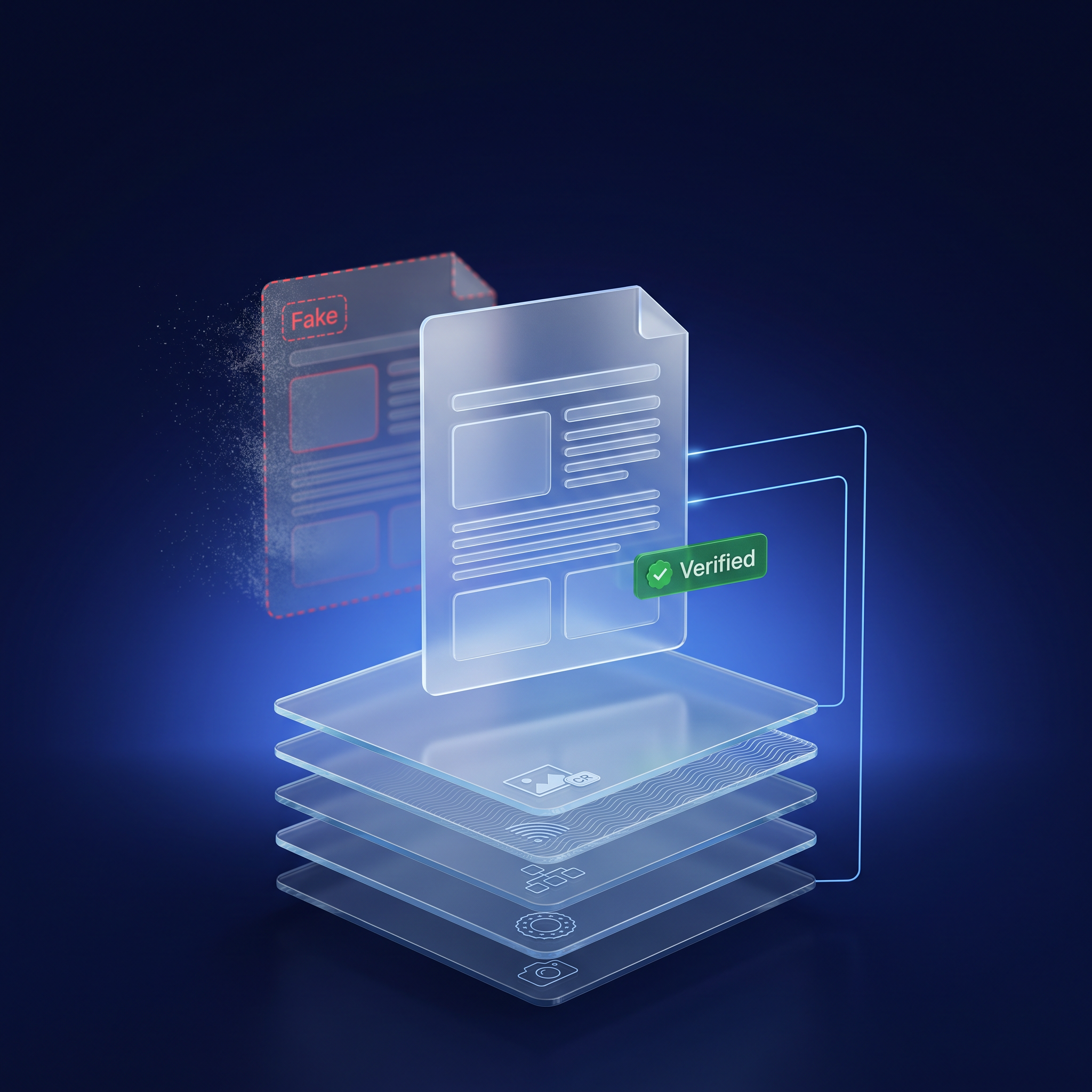
Three vendors pitched your team this month, and all three promised to "prove authenticity". The first signs images with content credentials. The second hides an invisible watermark in AI-generated videos. The third anchors every press release on a blockchain. Then your IT security team suggests eIDAS qualified seals, and your CEO asks one simple question: which of these protects us when a fake press release hits the wires?
The honest answer is that none of them covers everything. Each family of Digital Provenance solutions proves something different, for a different type of content, to a different audience.
This guide maps the five families available to companies in 2026, shows which one fits which content, and gives you the criteria to choose without ending up with a patchwork.
|
Why read this article 💡 |
Key takeaways
- Digital Provenance is now a board topic. Gartner lists it among its 10 strategic technology trends for 2026 and warns that companies that underinvest face sanction risks running into billions of dollars by 2029.
- No single solution covers everything. Content credentials, invisible watermarks, blockchain anchoring, eIDAS qualified trust services and certified capture each prove a different thing.
- Watermarking has reached industrial scale. Google says it has marked more than 180 billion images and videos with SynthID since 2023.
- Metadata alone rarely survives distribution. In an Indicator audit, platforms correctly labeled only 169 of 516 AI posts, just over 30%.
- Press releases need their own proof. C2PA was built first for media files, while releases and regulated disclosures travel as text, PDF, email and newswire.
Which Digital Provenance solution fits which content?
| Content | Best fit | What it proves |
|---|---|---|
| Press releases and regulated disclosures | Blockchain anchoring with public verification | The document comes from the issuer and has not changed since publication |
| Documents with legal or regulatory stakes | eIDAS qualified electronic seal and qualified timestamp | Origin, integrity and date, with a legal presumption across the EU |
| Executive portraits, product and crisis visuals | C2PA content credentials | Who signed the file, when, and which edits were made |
| AI-generated images, video and audio | Invisible watermark combined with C2PA | That AI produced or edited the content |
| Evidence of an event, a site or a web page | Certified capture | What was recorded, where and when |
Table of contents
- Why have Digital Provenance solutions become a priority for communications teams?
- What are the five families of Digital Provenance solutions?
- Which solution fits which type of corporate content?
- What criteria should a Dircom use to choose a solution?
- How can communications teams combine solutions without overloading their workflow?
- What should communications teams remember?
- FAQ
Why have Digital Provenance solutions become a priority for communications teams?
Gartner defines Digital Provenance as the ability to verify the origin, ownership and integrity of software, data, media and processes. In October 2025, the firm named it one of its top strategic technology trends for 2026. It also predicts that by 2029, organizations that fail to invest adequately will be exposed to sanction risks potentially running into billions of dollars.
What risks are pushing companies to act now?
- Deepfakes have gone mainstream. In a Gartner survey of 302 cybersecurity leaders, 62% of organizations reported a deepfake attack in the previous 12 months.
- Executives are prime targets. In the same survey, 43% reported at least one deepfake audio call incident, and 37% reported deepfakes in video calls.
- Trust is scarce. The Reuters Institute Digital News Report 2026 puts trust in news at 37%, its lowest level since 2015, and only 20% of respondents trust news from AI chatbots.
In this context, the question journalists and investors ask is no longer only "is this true?" but "does this really come from the company?"
What does the EU AI Act change in 2026?
Since 2 August 2026, the transparency obligations of Article 50 apply. Providers of generative AI must mark outputs in a machine-readable way, and deployers must disclose deepfakes and AI text published on matters of public interest.
- A practical framework: the Commission's code of practice on transparency of AI-generated content, drafted with more than 187 participants, gives the route to compliance.
- A short grace period: under the AI Omnibus, Regulation (EU) 2026/1744 of 8 July 2026, which simplifies the AI Act, generative systems already on the market before 2 August 2026 have until 2 December 2026 to apply marking.
- Real penalties: breaches of transparency obligations can cost up to €15 million or 3% of worldwide annual turnover, under Article 99 of the AI Act.
As a result, your team will increasingly need to show where official content comes from and how AI was involved in producing it.
What are the five families of Digital Provenance solutions?
How do C2PA content credentials work for visuals?
Content credentials attach a signed record, called a manifest, to a media file. It states who signed the file, when, with which tool, and which edits were made, including by AI. The C2PA (Coalition for Content Provenance and Authenticity) was founded in February 2021 by Adobe, Arm, the BBC, Intel, Microsoft and Truepic, and the Content Authenticity Initiative that promotes its standard now counts more than 6,000 members.
- Where you already meet them: photos taken with the Google Pixel 10, Sony professional video cameras, and the "CR" icon on LinkedIn.
- Best for: executive portraits, product visuals, crisis visuals and press kit images.
- Main strength: the standard is already built into the devices, software and platforms your teams use every day.
Our guide on C2PA and content credentials for PR teams details how to sign your first assets.
What do invisible watermarks like SynthID add?
An invisible watermark is embedded directly into the pixels or the audio signal when the content is generated. Unlike metadata, it travels inside the content itself, so it is designed to remain detectable after common edits such as compression.
Google DeepMind reports that it has watermarked more than 180 billion images and videos with SynthID since 2023, along with 240,000 years of audio. Its public detector opened to everyone on 7 October 2026, and the checks built into Search, the Gemini app and Chrome now handle more than 1 million requests a day.
- Best for: AI-generated visuals and audio that your team publishes, and checking suspicious media that claims to come from you.
- Main strength: marking happens automatically at generation, with no extra step for your teams.
How does blockchain anchoring prove where a document comes from?
At publication, the solution computes a hash of the document, a unique digital fingerprint, and anchors it on a blockchain with a timestamp. Anyone who holds the file can recompute the fingerprint and compare it. If a single figure has changed, it no longer matches.
- Best for: press releases, results announcements, regulated disclosures and annual reports, sent by email, wire, PDF or newsroom.
- Main strength: it works for text documents on every channel, and verification can be public.
Wiztrust Protect, for example, anchors each press release at the moment of publication. Journalists, investors and analysts can then verify a document for free, without an account, in under one minute.
What legal weight do eIDAS qualified seals and timestamps carry?
Under the eIDAS regulation (electronic identification and trust services), an electronic seal is the equivalent of a signature for a legal entity. A qualified electronic seal enjoys a presumption of integrity and correct origin of the data, and a qualified timestamp a presumption of accurate date and time. These presumptions apply in all 27 EU Member States.
Since 20 May 2024, eIDAS 2 has also created qualified electronic ledgers. Their records enjoy a presumption of uniqueness and authenticity, accurate dating and correct chronological order.
- Best for: documents with legal, contractual or regulatory stakes.
- Main strength: a legal presumption recognized in all 27 EU Member States, which complements blockchain anchoring when the stakes are legal.
When is certified capture the right tool?
Certified capture records a photo, a video or a web page together with signed data on time, place and device at the moment of capture. The most rigorous solutions follow the ISO/IEC 27037 forensic standard.
- Best for: evidence of an event, a site visit, or a defamatory web page before it disappears.
- Main strength: the proof is created at the very moment of capture, before the content can be altered.
Where does deepfake detection fit?
Detection tools estimate whether a piece of content is synthetic. They are especially useful in a crisis to spot suspicious content quickly, and they complement Digital Provenance effectively.
Gartner expects this market to grow fast: by 2027, 50% of enterprises will invest in disinformation security products or services, up from less than 5% in 2025.
Which solution fits which type of corporate content?
Interactive tool
Which Digital Provenance solution fits your content?
Answer three questions to get the solution that fits your case.
1. What content do you need to protect?
2. Who needs to verify it?
3. Do you need legal weight?
Recommendations by type of content to protect:
Since a court or a regulator must be able to verify it, the recommendation includes the legally binding option.
Blockchain anchoring with public verification
For a press release or financial information, the right solution is blockchain anchoring with public verification: the document's fingerprint is anchored at the moment of publication.
What it proves: The document really comes from the issuer and has not changed since publication.
How to verify it:
- Journalists and investors: They compare the document they received with the anchored fingerprint, for free and in under one minute, for example with Wiztrust Protect.
- Court or regulator: They rely on the anchoring timestamp, reinforced by an eIDAS qualified electronic seal to benefit from a legal presumption.
- General public: Publish the document on your official newsroom, with a visible verification link.
Need legal weight: add an eIDAS qualified electronic seal and qualified timestamp, which carry a presumption of integrity and origin in all 27 EU Member States.
Learn more about this solutionContent credentials (C2PA standard)
For an executive portrait, a product visual or a crisis visual, the right solution is to sign the file with C2PA content credentials.
What it proves: Who signed the visual, when, with which tool, and which edits were made.
How to verify it:
- Journalists and investors: They check the content credentials with a public verification tool and compare the file with the original published on your newsroom.
- Court or regulator: Keep the signed original and add an eIDAS qualified timestamp to date the file in a legally reliable way.
- General public: Some platforms, such as LinkedIn, display a "CR" icon on images that carry content credentials.
Need legal weight: add an eIDAS qualified timestamp to your original files.
Learn more about this solutionInvisible watermark combined with C2PA
For an AI-generated image, video or audio file, the right solution combines an invisible watermark, such as SynthID, with C2PA content credentials and the visible label required by the AI Act.
What it proves: That the content was produced or edited by AI, and with which tool.
How to verify it:
- Journalists and investors: They run the file through the provider's detector, for example Google's SynthID Detector, and read its content credentials.
- Court or regulator: Document your human review process: the transparency obligations of Article 50 of the AI Act apply since 2 August 2026.
- General public: Display the "AI-generated" label required by the AI Act directly on the content.
Need legal weight: keep the source files and add an eIDAS qualified timestamp to them.
Learn more about this solutionCertified capture
To prove an event, a site visit or the content of a web page before it disappears, the right solution is certified capture.
What it proves: What was recorded, where, when and with which device.
How to verify it:
- Journalists and investors: They check the signed capture report provided by the solution.
- Court or regulator: Choose a solution that follows a forensic standard such as ISO/IEC 27037 and timestamps every capture.
- General public: Share the capture with its verification report rather than a simple screenshot.
Need legal weight: check that the timestamp comes from a qualified provider on the EU trusted list.
Learn more about this solutionWhy do press releases deserve their own proof?
Because they move markets, and because AI engines now amplify them. In the Vinci case, the enforcement committee of the French market authority (AMF) found that Bloomberg began publishing dispatches one minute after receiving the fake release. Vinci's share price fell 18.28%, and Bloomberg was fined €5 million, a penalty reduced to €3 million on appeal.
The risk now extends to AI answers. In the monthly barometer that Wiztrust publishes with GetMint, a single outlet captured 52.7% of AI citations in banking. In IT services and consulting, the top 10 outlets concentrated 46.5% of citations, across more than 13,000 links and 2,300 queries.
In practice, if one dominant outlet relays a fake, the false version can shape most AI answers in your sector. A release whose origin can be checked in seconds gives that outlet a reason not to publish the fake, and gives you a reference for the correction. Our guide on getting AI to stop repeating a false claim after a denial explains the next steps.
What criteria should a Dircom use to choose a solution?
Before signing with a vendor, check these seven criteria:
- What exactly does the proof cover? Origin, integrity, date, AI involvement. Ask each vendor what its proof does not demonstrate.
- Who can verify it, and how fast? A journalist on deadline needs a free check, with no account, in under a minute.
- Does it survive distribution? Test email, wire, PDF and social networks, since platforms labeled just over 30% of AI posts in the Indicator audit.
- Does it carry legal weight? If you need a presumption before a court or a regulator, check that the provider appears on the EU trusted list.
- Is it automatic? The proof should be created at publication, from your newsroom or distribution tool, without an extra step.
- Does it cover your content types and channels? Releases, financial documents, visuals, video, and every language you publish in.
- Who holds the keys? Define who is authorized to sign, under which approval process, with legal and IT security.
Pro tip: ask every vendor for a live test. Send a real release, change one figure in the copy, and see how a journalist would spot the difference.
How can communications teams combine solutions without overloading their workflow?
The most robust approach is layered, with one solution per stage of the content lifecycle:
- Capture: certified capture and C2PA-compatible cameras for official visuals.
- Creation: watermark and C2PA for any AI-generated content.
- Publication: a proof of origin on every release and financial document, created automatically from the newsroom.
- Distribution: one official newsroom as the reference for journalists, investors and AI engines.
- Verification: a public verification page, written into your crisis playbook.
What does a 90-day roadmap look like?
- Month 1: map your official content by type and risk, and list the tools that already produce it.
- Month 2: activate a proof of origin on press releases and financial disclosures first, then sign executive portraits with C2PA.
- Month 3: write an AI transparency policy aligned with Article 50, add a verification step to your crisis plan, and train spokespeople and investor relations teams to point journalists to it.
This layered logic is the proof layer of a broader corporate trust stack against disinformation.
What should communications teams remember?
Digital Provenance is not a single product. It is a set of complementary solutions, and the right one depends on the content you publish and the audience that must trust it.
- Visuals: C2PA content credentials, ideally with a watermark for AI content.
- Press releases and regulated information: a proof of origin that anyone can check in under a minute.
- Legal stakes: eIDAS qualified seals and timestamps.
- Evidence: certified capture.
Your next step: this quarter, list your five most sensitive content types and check, for each one, what proof a journalist could verify in under a minute.
FAQ
What is the difference between C2PA and Digital Provenance for press releases?
C2PA is one Digital Provenance standard, designed first for images, video and audio. Its version 2.3 extends to text documents, but press releases and regulated disclosures still travel by email, PDF, newswire and newsroom, where metadata is easily lost. For these documents, communications teams usually rely on a document fingerprint anchored at publication, which any recipient can check against the original.
Do we need eIDAS qualified seals if our press releases are already anchored on a blockchain?
Not always. Blockchain anchoring with public verification answers the operational question of a journalist or an investor: does this document come from the company? A qualified seal adds a legal presumption across the EU, useful for contractual or regulatory documents. Some listed companies combine the two, depending on the stakes of each document.
Does the EU AI Act require communications teams to watermark their content?
The marking obligation falls on providers of generative AI tools, not on the companies that use them. As a deployer, your team must disclose deepfakes and AI-generated text published on matters of public interest, unless that text went through human review and editorial responsibility. In practice, choose tools that already mark their outputs, and document your review process.
How can journalists and investors verify that a press release really comes from us?
Publish every release from a single official newsroom and give each one a proof of origin that anyone can check. With Wiztrust Protect, journalists, investors and analysts verify a document for free, without creating an account, in under one minute. If a single figure has been altered, the check fails, which makes a fake far easier to expose.
Does Digital Provenance improve how AI engines cite our company?
It helps AI engines and journalists identify your official source, but citations also depend on how your newsroom is structured and on media coverage. In the Wiztrust study of the 40 CAC 40 newsrooms, newsrooms powered by Wiztrust reached a visibility score of 77.3 out of 100, against 58.8 for other solutions. 80% of them were cited by generative AI when they published their results, 33% more than companies using other solutions. To measure and correct how LLMs portray your brand, Blueprint GEO, the offer built by Wiztrust with GetMint for communication teams, identifies the outlets that feed their answers and adjusts your PR strategy accordingly.
 31 min