
What is disinformation security, and what should communications directors budget for it in 2027?
 On 17 November, 2026
 30 min
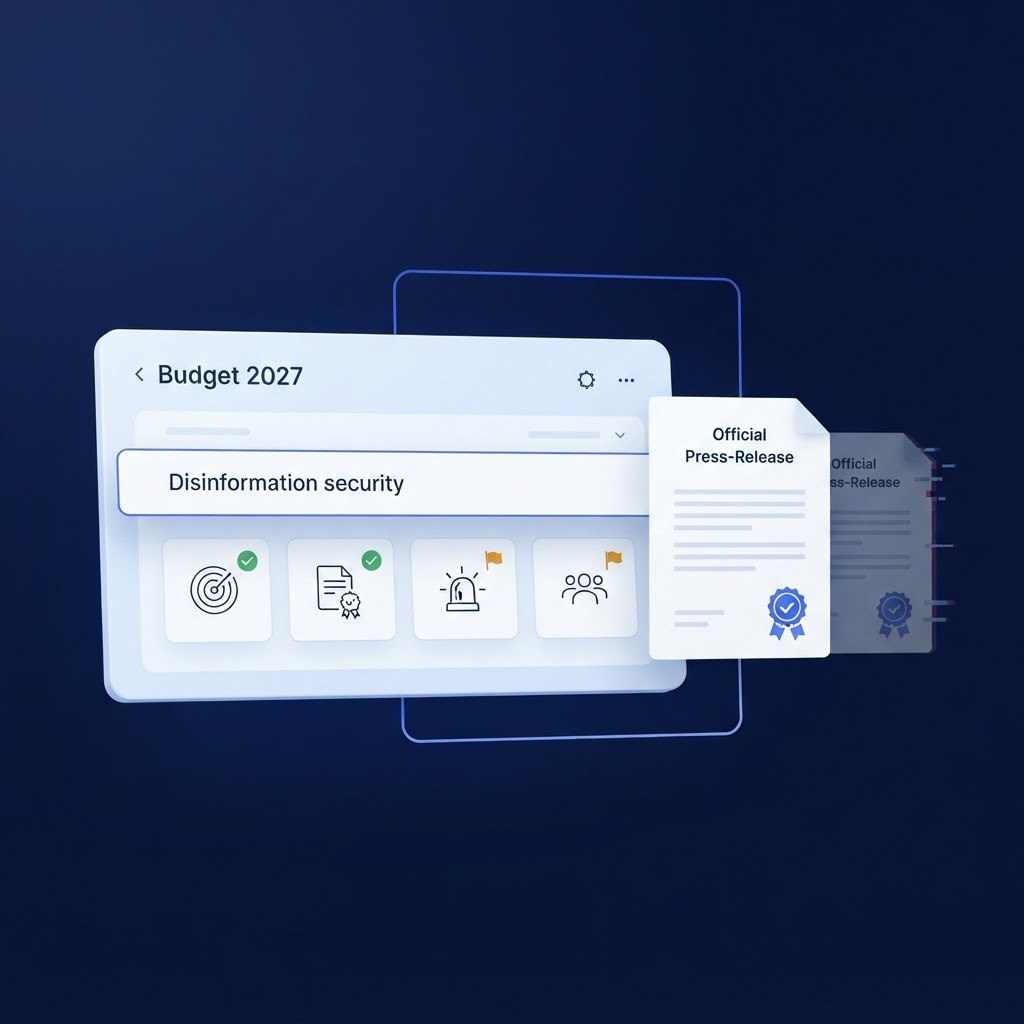
It is November 2026, and the 2027 budget review is under way. Your chief financial officer stops at a new line in the communications plan, "disinformation security", and asks two simple questions: what exactly are we buying, and why now?
Here is the short answer. Disinformation security is the set of practices and tools that protect a company from false content about it, such as fake press releases, executive deepfakes, cloned websites and manipulated narratives. Gartner expects 50% of enterprises to invest in it by 2027, up from less than 5% in 2025, and this guide turns that forecast into four budget lines you can defend.
|
Why read this article 💡 |
Key takeaways
- Investment is taking off. Gartner predicts that 50% of enterprises will invest in disinformation security and TrustOps by 2027, up from less than 5% in 2025.
- The money will come from existing budgets. In a forecast published in October 2025, Gartner expects spending against misinformation and disinformation to pass $30 billion by 2028, absorbing 10% of marketing and cybersecurity budgets.
- Risk leaders already rank it first. Information integrity became the top emerging risk in a Gartner survey of 337 senior risk and assurance executives in the first quarter of 2026.
- Audiences doubt what they see. According to the Reuters Institute Digital News Report 2026, trust in news fell to 37%, and 62% of people say they are concerned about fake news online.
- Budgets will not grow. 56% of chief marketing officers say they lack the budget to deliver their strategy, so every new line needs a clear business case.
The four disinformation security budget lines at a glance
| Budget line | What it pays for | Main cost driver | Lead owner |
|---|---|---|---|
| 1. Listening and narrative intelligence | Monitoring of media, social networks and AI answers, with alerts on emerging false narratives | Markets, languages and channels covered, and alert hours | DirCom, with the security team |
| 2. Content verification and Digital Provenance | A verifiable proof of origin for releases, financial documents and key visuals | Volume of official content and number of distribution channels | DirCom and investor relations, with IT security |
| 3. Response capacity | Escalation protocol, legal support, takedown requests and drills | On-call time, legal fees and number of simulations | Crisis communication lead, with legal |
| 4. Training and TrustOps governance | Trust council, training for spokespeople and employees, shared dashboard | Mostly internal time, plus training sessions | Executive committee sponsor |
Table of contents
- What does Gartner mean by disinformation security?
- What is TrustOps, and who runs it inside a company?
- Which threats does disinformation security cover for a listed company?
- What are the four budget lines for 2027?
- How does Digital Provenance fit into disinformation security?
- How should a communications director make the case to the executive committee?
- What should communications directors remember?
- FAQ
What does Gartner mean by disinformation security?
In a June 2026 Q&A for marketing leaders, Gartner analyst Andrew Frank argues that disinformation is no longer only a cybersecurity, legal or public affairs matter: it is a brand issue. Disinformation security is the response, made of products, services and operating practices that detect, verify and counter false content aimed at an organization.
In its November 2025 forecast, Gartner groups that response into four strategies:
- Content verification and certification, so audiences can tell authentic brand content from manipulated material.
- TrustOps, a cross-functional way of managing trust, steered by a trust council.
- Narrative intelligence and media listening, to detect and counter influence operations early.
- Behavioral science, to make employees and customers less receptive to false narratives.
How big is this market expected to become?
Big enough to reach the executive committee agenda:
- by 2028, enterprise spending against misinformation and disinformation should pass $30 billion, according to a Gartner forecast published in October 2025;
- at its September 2026 security summit, Gartner added that enterprises will spend more than $25 billion in 2030 just to authenticate digital content.
Disinformation security is therefore a budget envelope shared between communications, security and marketing, which the DirCom should help shape rather than inherit.
What is TrustOps, and who runs it inside a company?
Gartner describes TrustOps as an operational approach to protecting trust. It brings together the people, processes and technologies that reduce the risks coming from misinformation, harmful associations and deceptive content.
In practice, it rests on a trust council. Gartner's book World Without Truth recommends councils led by C-suite members from communications, IT, finance, legal, HR and marketing, because each function sees a different part of the threat.
Why does the communications team sit at the table?
- It owns the official channels: newsroom, press releases, executive statements and corporate social accounts.
- It knows the audiences to reassure first: journalists, analysts and investors.
- It already runs media monitoring, often the first source of early warning.
The model is spreading beyond companies: Gartner predicts that 40% of government organizations will set up dedicated TrustOps functions by 2028 to counter deepfakes. To decide who leads internally, our guide on who owns AI reputation internally compares the options between communications, marketing and SEO teams.
Which threats does disinformation security cover for a listed company?
The context explains the urgency. The World Economic Forum ranks misinformation and disinformation second among global risks over a two-year horizon in its Global Risks Report 2026. Meanwhile, the EU diplomatic service recorded 540 foreign information manipulation incidents in 2025, with France the second most targeted country after Ukraine and 27% of incidents involving AI.
Audiences are also harder to reassure: in the Reuters Institute Digital News Report 2026, 10% of people use AI chatbots for news every week, yet only 20% trust their answers.
Five threats to map, with the first signal and the first owner
| Threat | First signal | First owner | Budget lines |
|---|---|---|---|
| Fake press release | A journalist or analyst asks you to confirm a release you never issued | Press office, with investor relations | 2 and 3 |
| Executive deepfake (video or voice) | A clip or call attributed to the CEO or CFO circulates on social networks or messaging apps | Crisis communication lead, with security | 1 and 3 |
| Cloned newsroom or look-alike site | A domain close to yours publishes "official" content | IT security, with communications | 1 and 3 |
| Poisoned AI answers | An AI assistant repeats a false or outdated claim about the company | DirCom, with the digital team | 1 and 2 |
| Coordinated narrative campaign | A sudden spike of similar posts from new or anonymous accounts | DirCom, with security | 1 and 4 |
Look-alike sites are not a theory: during the French local elections of March 2026, a disinformation campaign relied on websites designed to look like local media, according to the Reuters Institute.
AI answers deserve special attention because they repeat third-party sources. Muck Rack's analysis of more than 25 million links found that earned media accounts for 84% of AI citations. As a result, a fake relayed by a widely read outlet can resurface in AI answers.
What are the four budget lines for 2027?
No public benchmark tells a DirCom how much to spend, since Gartner's figures describe a market, not a company. The practical approach is to fund the four lines that mirror Gartner's strategies, sized by their cost driver. They form the defense and proof layers of the corporate trust stack against disinformation.
What does the listening and narrative intelligence line cover?
- What it pays for: monitoring of media, social networks, messaging channels and AI answers, with alerts when a false narrative starts to spread.
- Cost drivers: number of markets and languages, channels covered, alert hours, and analyst time to qualify signals.
- Good practice: connect alerts to your coverage measurement. If your media monitoring already flows into Wiztrust Data, which links coverage to communication actions and tags it by spokesperson, campaign or competitor, narrative signals can sit next to your usual KPIs.
What does the content verification and Digital Provenance line cover?
- What it pays for: a verifiable proof of origin on press releases, financial documents and key visuals, detailed in the next section.
- Cost drivers: volume of official content, number of channels (email, newswire, newsroom, social networks) and integration with your publishing workflow.
What does the response capacity line cover?
- What it pays for: a written escalation protocol, contacts agreed in advance in legal, security and investor relations, takedown requests to platforms, and at least one drill a year.
- Cost drivers: on-call time, external legal fees and the number of simulations.
- Good practice: Gartner advises defining ownership, escalation paths and response protocols before a problem hits.
What does the training and TrustOps governance line cover?
- What it pays for: the trust council, training for spokespeople, investor relations and employees, and one dashboard for the executive committee.
- Cost drivers: mostly internal time, plus external training sessions.
- Why it matters: Gartner lists education, and nudges and incentives, among its four levers against disinformation, alongside rules and technology.
How should you size the overall envelope?
Start from what already exists. According to the Gartner 2026 CMO Spend Survey, marketing budgets are flat at 7.8% of company revenue, up from 7.7% in 2025. The same survey shows that CMOs allocate 15.3% of marketing budgets to AI initiatives, and protecting the brand against AI fakes is a fair claim on part of that money.
Then reallocate rather than add:
- shift part of your monitoring budget toward narrative and AI answer monitoring;
- include Digital Provenance in your newsroom or distribution contract when it renews;
- share governance costs with security and legal, who face the same threat.
Pro tip: before adding a separate line for Digital Provenance, ask your newsroom or distribution provider whether certification is already part of your contract.
Not sure where to start? Answer four questions to see which line to fund first.
Interactive tool
Which budget line should you fund first?
Each "no" points to a line to fund in 2027.
1 / 4
Do you see false narratives forming, including in AI answers?
You cannot answer what you cannot see.
If not: line 1
Monitor AI answers and messaging channels, with alerts. See line 1
2 / 4
Can a journalist verify your releases in seconds?
Every official document should carry a proof of origin.
If not: line 2
Certify releases and financial documents. See line 2
3 / 4
Is your escalation protocol written and tested this year?
Owners are set before the crisis.
If not: line 3
Write it with legal and security, then run a drill. See line 3
4 / 4
Does a trust council meet every quarter?
One council steers the four lines.
If not: line 4
Set up the council and one shared dashboard. See line 4
Your 2027 priorities
0lines to fund in 2027
- Line 1: Listening and narrative intelligence
- Line 2: Content verification and Digital Provenance
- Line 3: Response capacity
- Line 4: Training and TrustOps governance
All four lines are covered: fund drills and measurement.
How does Digital Provenance fit into disinformation security?
Detection tells you that a fake is circulating. Digital Provenance proves which version is yours. It is the proof layer of disinformation security: a certified original that journalists, investors and AI engines can check in seconds.
That proof matters because a few outlets can dominate a sector. In the barometer Wiztrust runs with GetMint, a single outlet captured 52.7% of AI citations in banking. If that outlet relays a fake, a large share of AI answers in the sector can follow.
For press releases and financial documents, solutions such as Wiztrust Protect anchor each document at publication. Journalists, investors and analysts then check it for free, without an account, in a few seconds, and the solution already helps secure more than €1.2 trillion in market capitalization.
To compare the options by content type, see our guide on which Digital Provenance solutions communications teams should choose in 2026.
How should a communications director make the case to the executive committee?
The executive committee funds a risk it understands, a cost it can compare and a move its peers are already making. Three arguments cover those needs.
Which regulatory exposure should you flag?
- Market abuse. Under the EU Market Abuse Regulation, spreading false information that misleads the market is market manipulation, punishable for legal persons by fines of up to €15 million or 15% of annual turnover. If a rumor explicitly relates to inside information whose disclosure you have delayed, MAR also requires you to disclose it as soon as possible.
- AI transparency. Since 2 August 2026, Article 50 of the EU AI Act requires deployers to disclose deepfakes and AI-generated text published on matters of public interest. Breaches can cost up to €15 million or 3% of worldwide annual turnover.
How do you show the cost of doing nothing?
- Recall that risk leaders already rank information integrity as their top emerging risk.
- Use your own exposure: market capitalization, number of releases per year, number of markets, and how long it would take today to prove that a release is fake.
Why does peer pressure help?
Gartner expects half of enterprises to invest by 2027. Presenting the line as catching up with peers is often easier than presenting it as a new risk.
What should the one-page memo contain?
- The risk in one sentence, with one recent example from your sector.
- Your current exposure: what you monitor, what you can prove and how fast you respond.
- The four budget lines, each with an owner and a cost driver.
- What you will reallocate, and from which budgets.
- Three indicators for the end of 2027: detection time, share of official content with a proof of origin, and number of drills completed.
What should communications directors remember?
Disinformation security is not a new department: it is a shared budget, and the DirCom has the most to lose if it is decided elsewhere.
- Listen: see false narratives forming, including in AI answers.
- Prove: give every official document a verifiable origin.
- Respond: write the protocol and test it before the crisis.
- Govern: give the program one council and one dashboard.
Your next step: before your 2027 budget is locked, take the four-question test above and bring the result to your CFO.
FAQ
What is the difference between disinformation security and cybersecurity?
Cybersecurity protects systems and data. Disinformation security protects what people believe about the company, on channels it does not control, such as social networks and AI answers. The two meet on impersonation, which is why trust councils include both communications and IT.
What does TrustOps cost?
Mostly time. A trust council meets a few hours each quarter, and its main expenses are training and drills. The tools it steers, such as monitoring or Digital Provenance, sit in the other budget lines.
Does the EU AI Act require disinformation security measures?
Not as such. Article 50 requires transparency: providers mark AI outputs, and deployers disclose deepfakes and AI-generated text on matters of public interest. A disinformation security program helps you show what is authentic and what was AI-assisted, which supports that compliance.
Which team should own disinformation security: communications, security or legal?
No single team. Communications usually leads on the narrative, the newsroom and the public response, security leads on impersonation and detection tools, and legal validates takedowns and disclosures. An executive committee sponsor arbitrates between them.
Can disinformation about our company end up in AI answers?
Yes, especially when a widely read outlet relays it, since AI assistants mostly cite third-party sources. Publish a dated correction on your newsroom and contact the outlets that relayed the fake. To measure and realign how LLMs portray your brand, Blueprint GEO, the offer built by Wiztrust with GetMint for communications teams, identifies the outlets that feed their answers.
 30 min